Each month, the State Examiner covers five topics including:
Legislative Issue Monitoring
Statehouse News: Education Policy (with links to news items)
State Budget and Finance Monitoring
National Reports Impacting Education
Advocacy Tips
Each topic includes a brief introduction. To read the full articles under each headline, click on the "+" sign next to the topic. Please find the pdf for readers who prefer to print a version of the November 2025 State Examiner.
Legislative Issue Monitoring
In each edition of the State Examiner, AESA monitors state-level legislation and legislative trends impacting educational service agencies and their client schools and districts. This month’s report for November 2025 examines state efforts to combat chronic absenteeism and school attendance related issues.
Chronic absenteeism has emerged as one of the most significant state legislative issues impacting K-12 education in 2025.
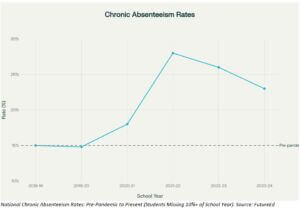
While chronic absenteeism has declined from its pandemic peak of 28 percent in 2021-22 to 23 percent in 2023-24, it remains far above pre-pandemic levels—representing approximately 14 million students who miss at least 10 percent of the school year. This persistent crisis has prompted an unprecedented shift: states are increasingly moving from local management to state-level legislative solutions, creating new opportunities and responsibilities for ESAs to support districts navigating these changing expectations.
The Legislative Landscape: A 2025 Snapshot
FutureEd has identified 56 bills across 22 states in the 2025 legislative session addressing chronic absenteeism and attendance challenges, with 15 bills already enacted. This legislative momentum represents a significant policy shift from viewing attendance as solely a local district matter to recognizing it as a state-level priority requiring coordinated intervention frameworks.
Key Enacted Legislation in 2025
Georgia's SB 123 prohibits expelling students solely for absenteeism and requires local school boards to establish attendance review teams and intervention plans for chronically absent students. Georgia lawmakers also passed HR 711 and SR 217, calling for comprehensive studies on absenteeism patterns and solutions.
Indiana's SB 482 bans punitive discipline based solely on truancy, while HB 1201 formally defined chronic absenteeism as missing 10 percent or more of the school year for any reason, distinguishing between excused and unexcused absences.
Virginia's HB 2601 strengthens attendance tracking requirements; mandating schools maintain not only daily attendance records but also class-by-class attendance data to ensure more accurate and detailed monitoring.
Texas's SB 991 adds chronically absent students to the definition of those "at risk of dropping out," expanding eligibility for intervention services and resources.
Ohio's approach through House Bill 96 removed the previous definition of "excessively absent" and replaced it with "chronically absent" to facilitate early intervention. Districts must adopt new chronic absenteeism policies by August 1, 2026, and Governor DeWine has set an ambitious goal of cutting chronic absenteeism in half by the 2028-29 school year.
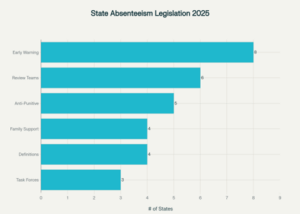
State Legislative Approaches to Addressing Chronic Absenteeism Click on the chart to see it in larger scale.
The 2025 legislative approaches can be categorized into several key strategies:
Early Warning and Data Systems — Eight states have enacted legislation requiring enhanced attendance tracking, including class-by-class monitoring. Virginia's HB 2601 exemplifies this approach, requiring schools to maintain detailed attendance records beyond simple daily presence.
Attendance Review Teams — Six states now mandate school-level intervention teams. Georgia's SB 123 requires local boards to establish attendance review teams with intervention plans for chronically absent students.
Anti-Punitive Measures — Five states have moved away from punitive approaches, prohibiting expulsion or punishment based solely on absenteeism. This shift recognizes that punitive responses often exacerbate underlying issues driving absences.
Definition and Threshold Standardization — Four states formally codified chronic absenteeism at the 10 percent threshold, providing clarity for data collection and intervention triggers.
Family Support and Engagement — Four states require family outreach and intervention plans, acknowledging that sustainable attendance improvement requires partnership with families.
Statewide Task Forces — Three states, including Maryland and Georgia, created commissions to study chronic absenteeism patterns and recommend comprehensive policy responses.
Why This Matters: The Policy Connections
Chronic absenteeism intersects with virtually every major k-12 education policy priority facing states in 2025, making it a lynchpin issue for ESAs working across multiple program areas. This presents opportunities for cross-jurisdiction and cross-agency partnerships that require coordination and facilitation; core roles for ESAs across the United States as convener, facilitator and broker of services regardless of where they are located or what they are called. Four key priority areas include the following:
Mental Health — Perhaps the most significant driver of current elevated chronic absence rates is student mental health. Since the pandemic, studies have found that anxiety and depression are the main drivers of health-related absenteeism. Poor mental health can be both a cause and an effect of absenteeism—when students miss school, their absence can lead to social isolation and loneliness, deepening mental health struggles for those with existing challenges. In its research, Attendance Works notes that educators across the country report student anxiety, depression, and sadness are more prevalent than ever before. The anxiety-attendance dynamic creates a worsening cycle: anxiety leads to absences, absences increase academic pressure and isolation, which exacerbates anxiety and leads to more absences.
Academic Achievement and Literacy — Research consistently demonstrates the strong connection between regular attendance and critical school measures and improved academic outcomes. Students who attend school regularly perform better in reading proficiency, overall academic achievement, and high school graduation rates. This connection is particularly acute given the Science of Reading reforms sweeping states—students cannot benefit from improved literacy instruction if they are not present to receive it.
Workforce Readiness — Chronic absenteeism also has long-term implications for workforce outcomes. One study exploring how absenteeism affects educational attainment and labor market outcomes found that absences have both short- and long-term negative impacts, with significant effects on exam performance and future employment prospects. Additionally, the state of Ohio's Attendance Taskforce recognized this connection, noting that successful attendance intervention means students "successfully participate in training, education and careers" and "have the skills to support their families in growing employment sectors".
Accountability Systems — With more than 70 percent of states using chronic absence as an indicator in their ESSA accountability systems, attendance data directly impacts school accountability ratings. As states reimagine accountability systems beyond test scores—a topic the AESA State Examiner addressed in September 2025—chronic absenteeism provides a critical non-academic measure of school effectiveness and student engagement.
National Chronic Absenteeism Trends Click on the chart to see it in larger scale.
The trajectory of chronic absenteeism nationally illustrates both the scale of the challenge and the progress being made:
Period
Chronic Absenteeism Rate
Pre-pandemic baseline (2018-19)
~15%
Pandemic peak (2021-22)
28%
Current rate (2023-24)
23%
Goal in many states
50% reduction by end of decade
While the decline from 28% to 23% represents meaningful progress, current rates remain roughly 50% higher than pre-pandemic levels. Southern states have been particularly impacted, with chronic absenteeism rates nearly double their 2018-19 levels in many communities.
How Educational Service Agencies Can Assist
ESAs are uniquely positioned to support districts navigating this evolving legislative landscape. Their intermediary role—connecting state policy with local implementation—makes them natural partners in attendance improvement efforts. Leading examples include the following:
Data Analysis and Early Warning Systems
ESAs can provide the data infrastructure and analytical capacity many districts lack. Ohio's Department of Education and Workforce specifically notes that "effective implementation of attendance initiatives relies on actionable attendance data, which Ohio districts can access through dashboards linked to their Student Information System and with guidance from credentialed Regional Data Leads at their State Support Teams or Educational Service Centers".
Recommended Actions:
Develop regional attendance dashboards with real-time data access
Train district staff on data interpretation and early warning indicators
Facilitate data-sharing protocols across districts to identify regional patterns
Professional Development and Capacity Building
Many attendance strategies require specialized training that individual districts cannot efficiently develop.
Recommended Actions:
Offer professional development on trauma-responsive approaches and their connection to attendance
Train staff on conducting effective home visits and family engagement
Provide coaching on implementing multi-tiered systems of support (MTSS) for attendance
Attendance Intervention Networks
Several ESAs have established collaborative networks that bring together attendance professionals across districts.
Facilitate monthly or quarterly convenings for attendance coordinators
Create shared resource repositories
Document and disseminate local success stories
Community Partnership Coordination
Addressing the root causes of chronic absenteeism often requires resources beyond what schools can provide. Washington State's OSPI specifically highlights that "community members, organizations, and businesses are critical partners in this work" and that ESDs (Educational Service Districts) play key roles in regional coordination.
Recommended Actions:
Employ Family & Community Engagement Liaisons
Develop regional inventories of community resources available to address attendance barriers
Establish Community Engagement Board protocols for intensive intervention cases
Coordinate partnerships with mental health providers, housing agencies, and transportation services
Technical Assistance for Policy Compliance
With new state legislation requiring districts to adopt chronic absenteeism policies, ESAs can provide critical technical assistance for compliance.
Recommended Actions:
Develop model policies aligned with new state requirements
Provide guidance on aligning local policies with juvenile court practices
Offer legal review support for attendance policy development
Special Population Support
Students with disabilities are among those most frequently absent from school, with chronic absence rates approximately 1.5 times higher than rates of non-disabled students. ESAs providing special education services can integrate attendance strategies into their support models.
Recommended Actions:
Include attendance as a regular discussion item in IEP/504 team meetings
Train special education staff on disability-specific factors contributing to absences
Ensure accessibility supports and accommodations are fully provided to remove attendance barriers
Bottom Line
The shift toward state-level chronic absenteeism legislation in 2025 represents a significant evolution in education policy. State lawmakers have clearly signaled that attendance is no longer solely a local concern but a statewide priority requiring coordinated intervention.
For ESAs, this legislative momentum creates both opportunity and responsibility. ESAs are uniquely positioned to serve as the connective tissue between state policy directives and local district implementation—providing the data infrastructure, professional development, collaborative networks, and technical assistance that effective attendance intervention requires. By positioning themselves as attendance improvement partners, ESAs can leverage their intermediary role to help ensure that every student has the opportunity to be present, engaged, and successful.
As states continue to refine their approaches—moving from punitive to supportive, from local to coordinated, from reactive to preventive—ESAs that build capacity in this policy area will be essential partners in addressing one of education's most pressing challenges.
State Budget and Finance Monitoring
AESA monitors state level budget and finance news impacting preschool and primary and secondary education. These curated articles (with links) can provide insights into what is happening in your state and collectively across the U.S. The latest state budget and finance-related news for November 2025 follows below.
Each month AESA finds representative examples (with links) of news items coming out of the states or impacting the states that may be of interest to ESAs and their client schools and districts:
AESA monitors state and national reports highlighting state-level information of interest to ESAs. As always, it is important to view these reports through a critical lens with attention to research design, methodology, data sources and citations, peer review, and publication venue. This month AESA spotlights reports from the National Association of State Budget Officials (NASBO), the Reason Foundation, and the Education Policy Institute.
With data gathered from all 50 state budget offices, this semi-annual report provides a narrative analysis of the fiscal condition of the states and data summaries of state general fund revenues, expenditures, and balances. This fall 2025 edition of the report contains data for states, territories, and the District of Columbia on general fund spending, revenue, ending balances, and rainy-day funds for fiscal 2024 (actual), fiscal 2025 (preliminary actual), and fiscal 2026 (enacted). Information on enacted changes to taxes and fees and employment compensation for fiscal 2026 is also included. Click Here to read the report.
This report includes School finance data and trends from 2002 to 2023. Readers can view a summary of each state’s K-12 finances, enrollment, staffing, teacher salaries, student outcomes, and more. Reason Foundation’s mission is to advance a free society by developing, applying, and promoting libertarian principles, including individual liberty, free markets, and the rule of law. We use journalism and public policy research to influence the frameworks and actions of policymakers, journalists, and opinion leaders. Click Here to read the report.
The school bus driver shortage continues to play out across the country, making it more challenging for students to get to school and placing additional burdens on the K–12 public education system. EPI’s analysis finds that school bus driver employment remains 9.5% below 2019 staffing levels. Click Here to read the full report.
The highlighted reports offer valuable insights. Taken together, these three reports underscore a bottom line for ESAs: states are entering a more constrained and uneven fiscal environment at the same time K–12 systems face structural cost pressures and persistent workforce and service challenges, so ESAs should be planning now to help their member districts do more with limited, less predictable resources. The NASBO Fiscal Survey of the States signals that while many states still have strong reserves, revenue growth is slowing, expenditure pressures are rising, and policymakers are weighing tax changes and compensation decisions that will shape future state aid, creating both risk and opportunity for ESAs that rely heavily on state funds and often serve as implementation partners for new initiatives. Reason Foundation’s K–12 Education Spending Spotlight highlights long‑run trends of rising per‑pupil spending, rapidly growing benefit and pension costs, staffing growth that outpaces enrollment, stagnant or declining real teacher salaries, and uneven student outcomes, suggesting that education leaders will face increasing pressure to demonstrate the return on investment of every dollar and to redirect funds toward high‑impact services. The EPI analysis of the school bus driver shortage shows how these macro-level trends play out on the ground, with transportation staffing still well below pre‑pandemic levels despite recent wage gains, creating daily disruptions for students and families and exposing the fragile nature of critical support services.
In states experiencing negative trends or outcomes in these areas, ESAs can respond by using these reports to brief boards and superintendents, stress‑test multi‑year financial plans, design shared‑service strategies that reduce fixed costs (especially around benefits and non‑teaching staffing), support districts in rethinking transportation and other hard‑to‑staff operations, and position themselves as neutral data interpreters who help local leaders navigate ideologically diverse analyses while maintaining a focus on what matters most: student access and outcomes.
Advocacy Tip
The AESA State Examiner is dedicated to equipping members with the insights, strategies, and tools they need to advance effective advocacy, influence policy outcomes, and foster meaningful change for schools and learners. Each edition is designed to build members’ understanding at both the strategic and tactical levels, illuminating practical ways to impact education policy and providing actionable knowledge to navigate an evolving policy landscape. The November 2025 edition turns its focus to the citizen-led petition process, exploring how this approach can serve as an alternative avenue for member organizations and stakeholders to drive policy change when conventional legislative action is limited or gridlocked.
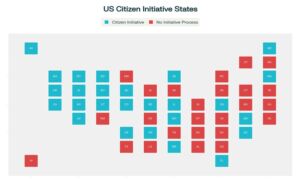
Citizen initiatives allow voters to directly shape law and policy through the collection of petition signatures and eventual placement of measures on the statewide ballot. Currently, 26 states and the District of Columbia provide some form of citizen initiative or referendum, while the rest rely exclusively on legislative referral.
There are three main types:
Initiated State Statutes: Allows citizens to propose new laws or amend existing ones without legislative approval.
Constitutional Amendments: Enables direct voter action to change state constitutions, usually with higher signature thresholds.
Veto Referendums: Allows voters to challenge and possibly overturn recently enacted legislation.
States differ in their processes (direct versus indirect), signature requirements (often a percentage of votes from recent statewide elections), geographic distribution rules, and timelines for collecting signatures.
States Permitting Citizen-Led Initiatives
The map highlights the states where citizen-led ballot initiative processes exist against those that do not.
Strategic Role of ESAs in Ballot Initiatives
Educational service agencies are uniquely positioned to lead or support citizen-led ballot initiatives when legislative efforts stall due to supermajority control or partisan gridlock.
ESAs can:
Build coalitions among educators, parents, and advocacy organizations to mobilize grassroots support.
Assist with public education and messaging around ballot measures, especially those addressing education policy (e.g., school funding, universal pre-K, voucher programs).
Provide legal and procedural guidance to ensure compliance with complex initiative rules.
Support signature collection and voter persuasion, leveraging regional networks and expertise.
Strategic Application in Advocacy Campaigns
Overcoming Legislative Obstacles
In states where a single party holds a supermajority in the legislature, traditional lobbying faces structural disadvantages. Supermajorities can:
Override gubernatorial vetoes
Control committee assignments and legislative calendars
Block minority party amendments and proposals
Advance partisan agendas without bipartisan negotiation
Ballot initiatives provide an alternative pathway by appealing directly to voters, who often hold more moderate or diverse views than legislative majorities. This is particularly effective when:
Public opinion polling shows strong voter support for a policy change
Legislative leadership has consistently blocked consideration of an issue
The policy crosses traditional partisan lines (e.g., criminal justice reform, healthcare expansion, education funding and school choice)
Grassroots coalitions can be mobilized for signature collection and voter education
Integration with Broader Advocacy Strategy
Ballot initiatives should not replace traditional lobbying but rather complement it as part of a multi-faceted advocacy strategy:
Pressure and Leverage: Threatening or launching an initiative campaign can pressure legislators to negotiate and compromise on policy reforms.
Grassroots Mobilization: Signature collection efforts build organizational capacity, expand coalition networks, and increase constituent engagement with the policy issue.
Public Education: Initiative campaigns provide a platform for sustained public education, media coverage, and narrative shaping around the policy issue.
Electoral Implications: High-profile ballot measures can drive voter turnout, potentially benefiting candidates who support the initiative or changing the composition of future legislatures.
Long-Term Policy Change: Even failed initiative campaigns can make previously unthinkable policies part of mainstream political discourse and set the stage for future legislative action.
Pros and Cons of Citizen-Led Initiatives
Advantages
Alternative Pathway: Offers a route to policy change when legislative action is blocked by partisan opposition or supermajority control.
Grassroots Engagement: Strengthens coalition-building and public engagement by mobilizing constituents around policy reform.
Public Education: Fosters debate and raises awareness, shifting policy discourse even if a measure does not pass.
Electoral Impact: Major initiatives drive voter turnout and can alter future legislative composition.
Drawbacks
Resource Intensive: Requires substantial funding, organizational capacity, and legal expertise for signature gathering, drafting, and campaigning.
Complexity: Initiatives face strict legal, procedural, and compliance hurdles; complicated policy issues may be oversimplified on a ballot.
Opposition: Well-funded adversaries can defeat even popular measures through sophisticated counter-campaigns.
Accountability: Initiatives lack the deliberation, testimony, and amendment process of the legislative system, risking unintended consequences.
Geographic Limits: In 24 states, ballot initiatives are not an option, so advocates depend on traditional legislative strategies.
Impact
Recent initiative campaigns have succeeded on issues where legislatures were gridlocked, such as Medicaid expansion, redistricting reform, and minimum wage increases in various states. Even failed campaigns can set the stage for future legislative or ballot victories by shifting public discourse.
Bottom Line
For ESAs and their stakeholders, citizen-led ballot initiatives are not a replacement for lobbying and advocacy, but a strategic complement—especially valuable when legislative channels are closed to change. The most effective advocacy blends initiatives with stakeholder engagement, coalition-building, traditional lobbying, and electoral action. As legislative polarization deepens in many states, mastering the ballot initiative process becomes ever more critical for achieving education policy goals and supporting client schools and districts.
AESA State Advocacy Resources for ESAs
State-level legislative advocacy plays a crucial role in shaping the educational landscape. While federal policies often set broad educational priorities, state legislatures hold significant power over the funding, governance, and standards that directly impact local schools and districts. AESA supports state-level advocacy by offering training through publications, workshops, and presentations, which can be customized for individual states.
AESA equips education leaders with the tools and confidence they need to be effective advocates through flexible, customized advocacy trainings. Whether you're looking for a deep dive or a quick overview, AESA offers three levels of training to fit your needs:
Three-Day Workshop: A comprehensive, step-by-step immersion into state advocacy. Participants gain a strong understanding of the legislative landscape, policy-making, and practical advocacy strategies.
One-Day Workshop: A focused format that delivers essential advocacy skills and actionable takeaways for leaders short on time.
One-Hour Presentation: Perfect for regional or local events, these expert-led sessions address state-specific challenges in politics, school finance, and education policy.
Need something unique? AESA can tailor a training to your goals, schedule, and audience. Every session is designed to build legislative knowledge, sharpen messaging, and empower participants to drive change at the state level.
Please contact Joan Wade, AESA Executive Director, for more information.
Educational Service Agencies play a critical role in supporting schools and districts, yet their unique needs and challenges often require tailored advocacy approaches. The recently released AESA Advocacy Guide recognizes the distinct position of ESAs and offers targeted strategies to help you navigate the complex landscape of education policy and funding.
Key Features of the toolkit include:
Audience Analysis
Message Development
Channels & Content
Advocacy Tactics
Advocacy is essential for ensuring that ESAs receive the support and recognition they deserve. With this specialized Advocacy Guide, you’re equipped to lead impactful advocacy efforts that can make a real difference. Download your copy today and take the first step towards stronger, more effective advocacy for your ESA.
SHARE YOUR ADVOCACY SUCCESS STORIES
AESA would like to highlight successful state-level advocacy campaigns. Share your triumphs in state advocacy with fellow members! Contribute to our newsletter by submitting your success stories – your experiences can enlighten and inspire others in navigating the often complex landscape of state advocacy. Together, we can amplify our collective knowledge for the benefit of the entire AESA membership. Send your stories to jwade@aesa.us.
STAY CONNECTED & INVOLVED
Have feedback for the AESA State Advocacy Team? Would you like to see a particular issue area addressed in future editions? Send feedback to jwade@aesa.us.
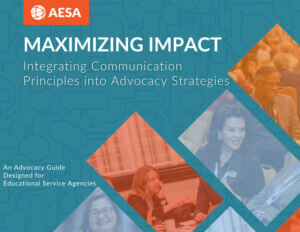 Educational Service Agencies play a critical role in supporting schools and districts, yet their unique needs and challenges often require tailored advocacy approaches. The recently released AESA Advocacy Guide recognizes the distinct position of ESAs and offers targeted strategies to help you navigate the complex landscape of education policy and funding.