February 2026: AESA State Examiner
February 27, 2026
Each month, the State Examiner covers five topics including:
- Legislative Issue Monitoring
- Statehouse News: Education Policy (with links to news items)
- State Budget and Finance Monitoring
- National Reports Impacting Education
- Advocacy Tips
Each topic includes a brief introduction. To read the full articles under each headline, click on the "+" sign next to the topic. Please find the pdf for readers who prefer to print a version of the February 2026 State Examiner.
Legislative Issue Monitoring
In each edition of the State Examiner, AESA monitors state-level legislation and legislative trends impacting educational service agencies and their client schools and districts. This month’s report for February 2026 examines state activity related to property tax reforms and related state initiatives.
State‑Level Property Tax Changes, Elimination Efforts, and Their Implications for Education Service Agencies
Property taxes are at the center of an intense new phase in state tax politics. They provide more than one‑third of all K‑12 funding nationwide, yet homeowners are facing some of the fastest property tax bill increases in more than a decade. At the same time, elected officials and activists in more than a dozen states are pushing big changes—including ending property taxes altogether in some places. For education service agencies (ESAs), these debates are not abstract; they could reshape budgets, services, and even the long‑term role of ESAs in state education systems.
This article focuses on a set of “high‑activity” states where property tax policy is changing quickly or where major proposals are on the table: Florida, Georgia, Indiana, Iowa, Kansas, Nebraska, New York, Ohio, Oklahoma, South Dakota, Tennessee, Texas, Utah, Wisconsin, and Wyoming. Even if your ESA is not in one of these states, the trends emerging there are early warning signs—and a guide—for what might come next.
Why Property Tax Reform Is Surging Again
State and local governments collected close to 800 billion dollars in property tax revenue in 2024, an 8 percent increase over 2023, which itself was nearly 9 percent higher than 2022—the fastest growth in at least a decade and a half. Much of this growth has come from rising residential property values, even as commercial property values have been flat or declining in many areas. That shift has put increasing pressure on homeowners, especially in fast‑growing or newly popular regions where remote work has driven migration and demand.
At the same time, state tax systems have become more volatile. Revenues have been buffeted by COVID‑era federal aid, shifts in consumer spending, and repeated rounds of state tax cuts. States that rely heavily on volatile revenue streams, like severance or corporate income taxes, face bigger swings, while those leaning more on stable sources like general sales and property taxes tend to be steadier. Yet many states are now deliberately trying to reduce reliance on property taxes, which had been one of their more stable “legs” in the traditional three‑legged stool of property, sales, and income taxes.
This has created fertile ground for bold proposals. According to a recent EducationWeek report, officials or activists in at least 10 states—Florida, Georgia, Kansas, Nebraska, Ohio, Oklahoma, Tennessee, Texas, Wisconsin, and Wyoming—have floated plans to eliminate homeowner property taxes, and at least six others are debating ambitious property tax relief. For ESAs and districts, that combination of rapid tax bill growth, political backlash, and revenue volatility raises serious questions about the stability and equity of school funding in the years ahead.
Recent Property Tax Reforms in High‑Activity States
Many of the most consequential changes for ESAs are not the headline‑grabbing elimination plans. Instead, they are caps, exemptions, and new rules that quietly restrict how much local revenue can grow over time.
New York has long limited annual property tax increases to about 2 percent and recently gave local governments more power to exempt homeowners aged 65 and older, shrinking the tax base even as costs rise. Wyoming has a 4 percent cap on property tax growth and will send a proposal to voters in 2026 to exempt 50 percent of a property’s assessed value from taxation. Utah now requires school districts to hold specific public hearings before raising taxes, and the state tax commission can block increases if local leaders do not follow every detail of the rules; in 2025, the commission blocked more than 40 million dollars in proposed school tax increases over procedural issues.
Ohio stands out as a “high‑activity” state where the legislature enacted four major property tax bills in the waning months of 2025. Together, House Bills 186, 335, 309, and 129 significantly change how school property tax revenues can grow and how county officials can control local levies:
- House Bill 186 (HB 186): Limits the growth of “outside” (voted) school district millage to the rate of inflation, while providing a state backfill for schools.
- House Bill 335 (HB 335): Limits revenue increases from “inside” millage (the first 10 mills) that arise from property reappraisals, effectively dampening the impact of rising values on local collections.
- House Bill 309 (HB 309): Modifies county budget commission laws to allow commissions to reduce or eliminate voted levies they deem “excessive” or “unnecessary.”
- House Bill 129 (HB 129): Fixes the “20‑mill floor” calculation by including emergency and substitute levies, which causes more levies to trigger tax reduction factors and limits revenue growth from rising values.
All four bills have downstream implications for Ohio ESAs, which rely on districts funded increasingly through compressed and constrained property tax streams layered onto a state system that already leans heavily on property taxes and sales taxes as major revenue sources.
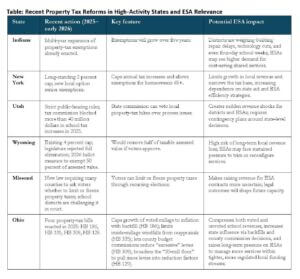
For ESAs, the lesson is that caps, exemptions, and governance rules can gradually squeeze local revenue even without any one dramatic cut. That squeeze often shows up first in deferred maintenance, fewer staff, and reduced programming—areas where ESAs are frequently asked to help districts “do more with less.”
2026: Where Property Tax Bills Are Moving Fastest
As of early 2026, more than a dozen states are actively debating major property tax reforms. Some proposals seek full elimination of homeowner property taxes. Others attempt narrower relief, such as new caps, expanded exemptions, or constitutional rules that make it harder to raise taxes in the future.
In Texas, the governor has made eliminating school property taxes by 2027 his central goal, even as the lieutenant governor and others promote more modest cuts. In Florida, the governor supports a bold constitutional amendment that would let voters decide whether to eliminate homeowner property taxes, even as some lawmakers advance bills that keep school property taxes intact. In both states, property tax relief would likely rely on state revenues—especially general sales taxes—which tend to be more volatile over the business cycle than property taxes.
Indiana and Ohio show how partial reforms can still create serious strain. In Indiana, a series of property tax exemptions set to phase in over five years is already pushing district leaders to consider postponing building repairs, scaling back technology, or moving to four‑day school weeks. In Ohio, the 2025 package of four bills—HB 186, HB 335, HB 309, and HB 129—creates complex new limits on local tax growth and adds state and county veto points over school levies. For Ohio ESAs, this means districts’ revenue capacity will be constrained both by state formula design and by local commissions’ conclusions about which levies are “excessive.”
Meanwhile, states like Kansas, Oklahoma, Tennessee, Utah, and New York are exploring or enforcing policies that require voter approval, supermajorities, or state‑level veto power before taxes can rise. These policies may slow tax increases, but they also make local education funding subject to complicated politics and procedural traps, adding another layer of volatility alongside economic factors.
Eliminating Property Taxes: Big‑Bang Proposals and Ballot Measures
 The most dramatic proposals aim to eliminate property taxes entirely, especially for homeowners. These ideas make powerful campaign messages but face serious fiscal and political hurdles. Replacing billions of dollars in property tax revenue with sales or income taxes is difficult, and often regressive, especially in rural or low‑wealth communities. Sales taxes and some income taxes are also more volatile than property taxes, making it harder to plan long‑term education budgets.
Still, the pressure is real. Activists or officials in Florida, Georgia, Kansas, Nebraska, Ohio, Oklahoma, Tennessee, Texas, Wisconsin, and Wyoming have recently pitched eliminating homeowner property taxes, with some proposals also targeting business property taxes. In several states, the action is moving directly to voters through ballot measures.
- In Tennessee, voters could decide in 2026 whether to ban a statewide property tax, limiting a potential future backstop for school finance.
- In Wyoming, voters will decide whether to exempt 50 percent of assessed value from taxation.
- In Nebraska, anti‑tax activists are gathering signatures for a 2026 constitutional amendment that would ban property, inheritance, and income taxes, forcing a complete redesign of the state’s revenue system.
- In Ohio, a citizens’ group is pushing a 2026 ballot measure to abolish property taxes; the governor warns it could require a 20 percent sales tax to backfill losses, with devastating impacts on schools and other local services.
It is worth recalling that voters have never approved statewide property tax abolition. Most recently, nearly two‑thirds of North Dakota voters rejected such a proposal in 2024. But even failed measures can drive compromise policies, such as tighter caps or broad exemptions, that alter school funding for years. The fear of “what if” can drive dramatic change, so be prepared.
For ESAs, pending legislation adds uncertainty in at least three ways:
- Districts may delay or renegotiate multi‑year contracts while awaiting legislative decisions.
- Districts may swing quickly between “expansion” and “cutback” modes as proposals advance or stall.
- States that lean more heavily on volatile revenue streams, like sales or severance taxes, may pass more risk along to ESAs and districts when downturns occur.
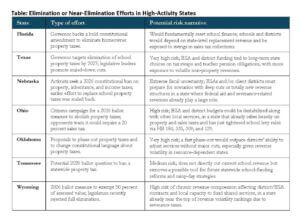
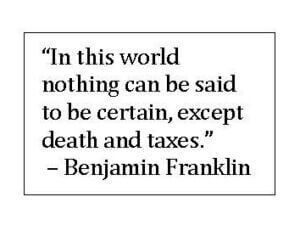 These efforts raise major risks for ESAs. Replacement taxes, especially sales taxes, tend to be more volatile and more regressive, potentially increasing pressure on ESAs to support high‑need districts as gaps widen. On the other hand, if states centralize more funding and accountability in response to elimination or large tax swaps, ESAs may gain a stronger role as regional implementation partners for equitable investments and targeted relief. This is a position service agencies should be prepared to advance and have the data and stories to back the efforts.
What ESA Leaders, Staff, and Governing Boards Should Do Next
The property tax debate is moving quickly and will likely remain politically charged for years. ESAs cannot control it, but they can prepare for it and help shape more responsible outcomes.
- Map Your Exposure
First, determine whether your ESA operates in one of the high‑activity states highlighted here—especially Florida, Georgia, Indiana, Iowa, Kansas, Nebraska, New York, Ohio, Oklahoma, South Dakota, Tennessee, Texas, Utah, Wisconsin, or Wyoming. If you do, assign a staff member or small team to track all major property tax bills and ballot measures and to brief leadership regularly.[2][3]
Next, quantify how much of your ESA’s revenue—and your client districts’ revenue—comes from property‑tax‑dependent local sources, including levies subject to caps, exemptions, or voter approval rules. In Ohio, for example, that includes assessing which member districts are most affected by HB 186’s inflation cap and backfill, HB 335’s inside‑millage limits, HB 309’s new county commission powers, and HB 129’s broader “20‑mill floor.”
Finally, understand how exposed your state is to overall revenue volatility, including reliance on more volatile tax types or sectors. States that lean heavily on severance or highly progressive income taxes, or that have recently cut taxes aggressively, should be especially careful to plan for downturns.
- Engage Early in State Policy Discussions
ESAs are trusted technical experts. Use that credibility to offer nonpartisan analysis to governors’ offices, legislative fiscal staff, and tax committees. Explain in clear terms how specific proposals—like caps, exemptions, elimination, or Ohio‑style packages of multiple bills—would affect ESA contracts and the services districts rely on.
Where possible, support targeted relief approaches, such as income‑based “circuit breakers,” that help homeowners manage tax bills without flattening the entire local tax base. Make the case that stable, adequate school funding is a core public service, on par with public safety and infrastructure, and that tax reforms should be paired with long‑term strategies for managing volatility, such as rainy‑day funds and careful use of one‑time surpluses.
- Plan for Multiple Financial Scenarios
Build simple three‑to‑five‑year scenarios for your ESA budget and service portfolio:
- Scenario A: Modest caps and exemptions, with slow but steady erosion of local capacity, as in cap states like New York or Wyoming.
- Scenario B: Aggressive tax relief with partial state backfill tied to sales or income taxes, as envisioned in Ohio’s HB 186 or some Texas and Florida concepts.
- Scenario C: Partial or near‑full elimination proposals that shift heavily to volatile revenue sources, as in elimination rhetoric in Texas, Nebraska, and Ohio’s ballot discussions.
For each scenario, identify which services are essential to protect and which could be restructured, consolidated, or delivered in new ways. Use examples from Indiana, Ohio, Utah, New York, and Wyoming to ground your planning in real‑world experiences like four‑day weeks, blocked tax increases, and deep base exemptions.
- Prepare Your Board and Member Districts
Schedule a board work session focused on property tax trends in your state and region. Use the tables in this article and state‑specific examples—such as Ohio’s four bills, ballot measures in Tennessee and Wyoming, and cap regimes in New York and Wyoming—to show the practical stakes for ESA budgets and services.
Provide clear, plain‑language talking points for board members and superintendents that connect tax proposals to staffing levels, program offerings, facility upkeep, and your ESA’s role in equity and shared infrastructure. Emphasize that “small” changes in property tax policy, like caps or new approval rules, can add up over time and may interact with state revenue volatility in ways that amplify risk.
- Move From Monitoring to Action
The politics of property taxes are unlikely to cool down soon. While sweeping elimination proposals may fail at the ballot box, their influence can still produce policies through reactive legislative action that weaken school funding and strain ESA budgets over time.
ESA leaders, staff, and boards can respond by:
- Staying informed about the details of property tax proposals in high‑activity states.
- Assessing and documenting the ESA’s financial exposure to property tax changes and to broader state revenue volatility.
- Engaging constructively with state policymakers to design reforms that ease tax burdens without undermining core educational services.
- Working with districts to develop realistic, student‑centered plans for different funding futures, including more centralized, more volatile, or more constrained systems.
By taking these steps now, ESAs can help ensure that efforts to fix problems with property taxes do not create deeper problems for students, educators, and communities.
State Budget and Finance Monitoring
AESA monitors state level budget and finance news impacting preschool and primary and secondary education. These curated articles (with links) can provide insights into what is happening in your state and collectively across the U.S. The latest state budget and finance-related news for February 2026 follows below.
Illinois Lawmakers Announce Plan to Close School Funding Gap
Chicago Sun Times
$1.2 billion tax rebate, $850 million in property tax relief approved in state budget
WSBTV Georgia
DeWine Warns on Property Taxes
5 News Cleveland
Federal School Choice Tax Credit Program Struggles to Get Blue State Traction
The Hill
In Some State, A Push to End All Property Taxes for Homeowners
LA Times
School Choice Programs Grow in Popularity and Cost
Stateline
Federal Cuts Hit State Budgets Hard
Cronkite News
More Red States Eye the No Income Tax Model
The Christian Science Monitor
Pennsylvania Leaders Want to Avoid Another Lengthy State Budget Impasse
The Sentinel
5 State Fiscal Debates to Watch
Pew
Statehouse News: Education Policy
Each month AESA finds representative examples (with links) of news items coming out of the states or impacting the states that may be of interest to ESAs and their client schools and districts:
As school cellphone bans gain in popularity, lawmakers say it’s time to go bell-to-bell
Stateline
$35 million per year investment in summer school is paying off, Oregon education officials say
Oregon Capital Chronicle
States race forward on education AI regulations despite Trump objections
The Hill
NM Legislature Passes Math, Literacy Bills
Source NM
CT School Leaders on Lamont’s K12 Education Budget
CT Mirror
Iowa House panel raises per-pupil school funding proposal to 2.25%
Iowa Capital Dispatch
Can the Politics of Schools Be Fixed?
Chalk Beat
More States Are Calling for Math Reform. Will It Improve Student Outcomes?
Education Week
The Biggest Issues to Watch in 2026
Governing
National Reports Impacting Education
AESA monitors state and national reports and policy briefs highlighting state-level information of interest to ESAs. As always, it is important to view these reports through a critical lens with attention to research design, methodology, data sources and citations, peer review, and publication venue. This month AESA spotlights reports from the General Accounting Office (GAO), XQ Institute, PEW Research Center and The Conversation.
A January 2026 GAO‑covered brief highlights that many districts face barriers—including limited staff training, procurement challenges, and lack of clear policies—in fully leveraging assistive technology for students with disabilities. GAO was asked to review how schools make decisions about providing assistive technology to students with disabilities. This report describes (1) the assistive technology selected school districts provide to students and the challenges they face doing so, and (2) strategies and resources selected school districts use to provide assistive technology to students and mitigate challenges. To learn more, click here.
Today’s world, the nonprofit XQ Institute argues in its new report The Future Is High School, “requires an entirely new kind of educational experience — one that traditional high schools were never designed to deliver,” the report found. For more information click here.
In December 2025, PEW Research Center released the findings of a report on teen use of social media and artificial intelligence (AI). A February 2026 article dives deeper into their feelings and those of their parents on their views and use of AI. Roughly 1 in 5 U.S. teens say they are on TikTok and YouTube almost constantly. At the same time, 64% of teens say they use chatbots, including about 3 in 10 who do so daily. For more, go here.
A review of studies by “The Conversation” demonstrates mixed results from state policies and provides some lessons learned. By the late 2010s, most states had adopted some form of dyslexia legislation. As of 2025, all states except Hawaii have enacted dyslexia legislation. While the laws shared similar goals of promoting early screening for reading difficulties, improving reading instruction and expanding support for struggling readers, they varied widely in strength, funding and expectations for schools. Learn more here.
These reports and related articles underscore that schools are under pressure to change, but practice often lags new laws and emerging technologies. Challenges remain even when states pass laws, buy tools, or expand digital access. This highlights the importance of the ESA role is supporting the transition from policy to practice. Together, these findings may serve as a call on ESAs to act as hubs for putting policy into practice—supporting assistive technology, AI, and high school redesign—and to build data and evaluation systems that help districts see what works and adjust quickly to boost students’ access, engagement, and achievement.
 Advocacy Tip: Building Coalitions that Win
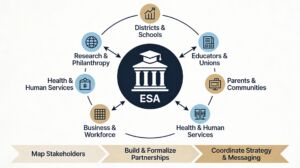 Advocacy Tip: Building Coalitions that Win
As policy and political dynamics become more tense and polarized, retail lobbying alone may not be enough to get your issue across the finish line. This is particularly true with contentious issues like property tax reform tackled earlier in this issue of the State Examiner. That’s where finding strategic partners is critical.
Coalition-building is one of the most powerful tools educational service agencies (ESAs) have to win at the statehouse, especially in an era of tight budgets, polarized politics, and fast-moving policy debates (particularly in states with short legislative sessions). When ESAs connect and lead coalitions well, they expand influence, share risk, and turn "good ideas" into actionable results and ultimately law.
State policy outcomes often reflect which voices are organized, visible, and persistent—not just who is "right" on the merits. Coalitions help ESAs:
- Combine reach across rural, suburban, and urban communities, making it harder for policymakers to ignore the issue.
- Share data, stories, and technical expertise that individual organizations cannot generate alone.
- Sustain long-term campaigns across election cycles and leadership changes.
- Amplify impact and create broader support for collaborative solutions.
For ESA leaders, coalition work is not "extra." It is core to protecting and advancing the ESA role in teaching and learning, specialized services, school improvement, and regional innovation.
Three types of partners you need
Winning coalitions usually include three broad groups:
- Like-minded partners
These are organizations that already share most of your goals and values—your natural allies and resource providers.
Examples include:
- Other ESAs and their member districts
- State principal and superintendent associations, teacher and staff organizations, and school boards
- Community school, afterschool, or equity coalitions focused on funding and student support
Like-minded partners help you move quickly, align messaging, and demonstrate broad K–12 consensus.
- Unlikely allies
Unlikely allies bring credibility with audiences that do not usually listen to traditional K–12 advocates. They can shift the narrative from "education insiders want more" to "the whole community is asking for change."
Potential unlikely allies include:
- Business and workforce groups, chambers of commerce, and industry sectors worried about talent pipelines
- Health, mental health, juvenile justice, and child welfare organizations that see school policies as upstream prevention
- Faith leaders, parent advocacy networks, civil rights organizations, disability and immigrant rights groups
- Rural economic development groups or farm bureaus in states where rural voice carries weight
These partners may not agree with you on every education issue, but they share enough interests on specific priorities—such as broadband, school funding equity, or student mental health—to stand together.
- Enabling partners
Enabling partners do not always lobby or testify, but they make coalitions more effective.
Examples:
- Research centers and foundations that provide data, policy analysis, and evaluation
- State and regional networks (such as community school coalitions) that support training, communication, and organizing
- Philanthropic or community organizations that can host convenings or offer small grants for local advocacy
ESAs can often serve as both core advocates and enabling partners, by bringing statewide data, implementation expertise, and convening capacity.
A strategic approach makes it more likely you will recruit the right partners for the right campaign.
Step 1: Map the landscape and analyze power
Before you invite anyone, clarify your policy goal, timeline, and non-negotiables. Then conduct stakeholder mapping across four categories:
- Supporters: Natural allies, resource providers, and public advocates who already back your initiative
- Opponents: Those likely to resist your proposed changes, including competing interests, status quo defenders, and resource competitors
- Decision-makers: Policy gatekeepers, funding controllers, and approval authorities with formal power
- Neutral parties: Potential allies, undecided influencers, and the general public who could swing either way
This mapping helps you see where ESAs are natural leaders and where they should support or join an existing coalition instead of creating a new one.
Next, identify existing networks and campaigns in your state focused on funding, equity, community schools, or accountability. Note past conflicts or "turf issues" that could derail collaboration, such as disputes over funding formulas or program control.
Step 2: Know when to engage
Not every potential partner is worth the effort. Engage when partnerships offer:
- Common goals: Aligned missions for mutual benefit
- Resource access: Meaningful resource sharing that extends your capacity
- Broader support: Collaborative solutions that gain more traction than solo efforts
- Amplified impact: Strategic alliances that enhance overall effectiveness
Step 3: Make targeted invitations
When you reach out:
- Lead with shared interests, not organizational needs: "We want to increase access to high-quality mental health services for students statewide" rather than "We need more ESA funding"
- Be clear about the opportunity: policy window, expected timeline, and concrete ways to participate (sign-on letters, testimony, district stories, local events)
- Start with 1–2 small, time-bound asks (such as co-signing a brief, sharing a survey, or hosting a local listening session) so partners can "test" the coalition without over-committing
A simple two-page concept memo or slide deck can help potential partners see the value quickly.
Step 4: Conduct due diligence
Before formalizing any partnership, research thoroughly. Ask:
- What is this organization's track record on similar issues?
- Are their goals truly aligned with ours, or just adjacent?
- Do they have a history of selective participation (only engaging when convenient)?
- Have they made side deals that undermine collective goals in the past?
Inadequate due diligence is one of the fastest routes to coalition failure.
Coalitions fall apart when communication is weak, roles are fuzzy, or victories are not shared.
Clarify structure and roles
You do not need a complex governance model, but you do need clarity.
- Define a small steering group (which may include ESA staff) responsible for strategy and rapid decisions
- Outline working groups by function—policy and research, communications, grassroots organizing, legislative outreach[1][3]
- Specify expectations: meeting cadence, decision rules, who can speak publicly, how sign-on decisions are made
- Formalize relationships with clear agreements on roles, messaging, and resource sharing
Put this in a short, plain-language "coalition agreement" that all partners receive.
Communicate predictably and maintain networks
Busy leaders stay engaged when they know what is happening and what is needed.
- Send brief updates with three items: where the bill or issue stands, what the coalition is doing this week, and what you need from partners
- Maintain a shared calendar of hearings, key meetings, and public events
- Use simple tools—email lists, a shared folder, and 30-minute virtual huddles during intense periods
- Schedule regular check-ins to strengthen relationships through consistent communication[4]
- Create reciprocal value through information sharing and intelligence gathering about organizational changes
Network maintenance reduces friction and eases future bureaucratic challenges, even when you are not actively campaigning.
Whenever possible, highlight partner wins in your communications so everyone sees their fingerprints on progress.
Build and protect trust
Trust is a coalition's most fragile asset.
- Be honest about differences within the coalition and name them directly instead of papering over conflict
- Avoid surprising partners with last-minute changes in strategy or messaging
- Share data, polling, and legislative intelligence widely, unless confidentiality is essential
- Watch for warning signs: selective participation, side deals, or misaligned expectations[4]
If an issue is too divisive for some members (for example, a culture-war amendment added to your bill), consider forming a narrower "tactical subgroup" to respond, while keeping the broader coalition focused on shared priorities.
Building consensus on strategy and messaging
Coalitions work best when there is a simple, shared story and a clear plan.
Co-create the agenda
Rather than presenting a finished platform, invite partners to shape it.
- Start with 1–3 top-line goals that everyone can support, such as "fair and adequate school funding," "safe and supportive schools," or "high-quality services statewide"
- Translate these into 2–4 specific policy asks for the current session (for example, a targeted funding increase, a grant program, or a statute change recognizing ESAs)
- Use data and stories from multiple partners to justify each ask, so it does not look ESA-centric
This process takes time but pays off in deeper buy-in and better testimony.
Craft compelling, tailored messages
Unifying around a few key messages makes it easier for policymakers and media to remember you. Apply these principles:
- Agency-specific language: Use terminology familiar to your target audience—whether legislators, agency staff, or the public—and adopt their priorities and framing
- Evidence-based approach: Support arguments with relevant data and quantify benefits using metrics your audience values
- Multiple perspectives: Frame issues from fiscal, social, and educational angles to address diverse stakeholder concerns
- Tailored materials: Develop specialized talking points for each messenger type (ESAs, business leaders, parents, educators)
Center on student impact, using language that resonates in your state (readiness, opportunity, safety, workforce). Provide one-page message guides with: problem, solution, why now, and what you are asking the state to do.
Encourage partners to adapt the language to their voice while keeping the core story intact.
Leverage relationships strategically
Utilize existing connections within agencies and map out second-degree connections that can open doors. When appropriate, use the authority and credibility of coalition partners to cut through red tape and accelerate decision-making.
To put this into practice in the next 90 days, ESA leaders, administrators, and board members can:
- Identify one priority issue where coalition support could change the outcome this year (for example, ESA funding, regional special education services, community schools, or student mental health).
- Conduct stakeholder mapping: list supporters, opponents, decision-makers, and neutral parties, then identify at least five like-minded partners, three unlikely allies, and two enabling partners to approach.
- Complete due diligence on potential partners before reaching out—review their track record, goals alignment, and past collaboration history.
- Draft a one-page coalition concept note and host a 60-minute virtual meeting to test interest and refine the shared agenda.
- Agree on 1–2 visible actions within the next month—such as a joint sign-on letter, a coordinated "day at the statehouse," or a series of local press events featuring multiple coalition voices.
- Build simple infrastructure: a shared email list, a quarterly coalition calendar, and a rotating schedule of partner-led stories or testimony.
- Establish regular check-ins and information-sharing protocols to maintain relationships even during non-campaign periods.
ESAs are uniquely positioned to connect districts, communities, and statewide networks around a common agenda. With intentional coalition-building—grounded in trust, shared purpose, and disciplined strategy—ESAs can turn that position into winning campaigns that strengthen services for the districts, students and families they serve.
AESA State Advocacy Resources for ESAs
State-level legislative advocacy plays a crucial role in shaping the educational landscape. While federal policies often set broad educational priorities, state legislatures hold significant power over the funding, governance, and standards that directly impact local schools and districts. AESA supports state-level advocacy by offering training through publications, workshops, and presentations, which can be customized for individual states.
Miss a report or want to refer back to a past issue? Stay informed with state-level legislative trends, education policy developments, and advocacy insights from across the country. Explore the full archive to revisit past editions, track emerging themes over time, and strengthen your understanding of the policy landscape shaping your work every day.
AESA equips education leaders with the tools and confidence they need to be effective advocates through flexible, customized advocacy trainings. Whether you're looking for a deep dive or a quick overview, AESA offers three levels of training to fit your needs:
-
Three-Day Workshop: A comprehensive, step-by-step immersion into state advocacy. Participants gain a strong understanding of the legislative landscape, policy-making, and practical advocacy strategies.
-
One-Day Workshop: A focused format that delivers essential advocacy skills and actionable takeaways for leaders short on time.
-
One-Hour Presentation: Perfect for regional or local events, these expert-led sessions address state-specific challenges in politics, school finance, and education policy.
Need something unique? AESA can tailor a training to your goals, schedule, and audience. Every session is designed to build legislative knowledge, sharpen messaging, and empower participants to drive change at the state level.
Please contact Joan Wade, AESA Executive Director, for more information.
 Educational Service Agencies play a critical role in supporting schools and districts, yet their unique needs and challenges often require tailored advocacy approaches. The recently released AESA Advocacy Guide recognizes the distinct position of ESAs and offers targeted strategies to help you navigate the complex landscape of education policy and funding.
Key Features of the toolkit include:
- Audience Analysis
- Message Development
- Channels & Content
- Advocacy Tactics
Advocacy is essential for ensuring that ESAs receive the support and recognition they deserve. With this specialized Advocacy Guide, you’re equipped to lead impactful advocacy efforts that can make a real difference. Download your copy today and take the first step towards stronger, more effective advocacy for your ESA.
SHARE YOUR ADVOCACY SUCCESS STORIES
AESA would like to highlight successful state-level advocacy campaigns. Share your triumphs in state advocacy with fellow members! Contribute to our newsletter by submitting your success stories – your experiences can enlighten and inspire others in navigating the often complex landscape of state advocacy. Together, we can amplify our collective knowledge for the benefit of the entire AESA membership. Send your stories to jwade@aesa.us.
STAY CONNECTED & INVOLVED
Have feedback for the AESA State Advocacy Team? Would you like to see a particular issue area addressed in future editions? Send feedback to jwade@aesa.us.