April 2026: AESA State Examiner
May 1, 2026
Each month, the State Examiner covers five topics including:
- Legislative Issue Monitoring
- Statehouse News: Education Policy (with links to news items)
- State Budget and Finance Monitoring
- National Reports Impacting Education
- Advocacy Tips
Each topic includes a brief introduction. To read the full articles under each headline, click on the "+" sign next to the topic. Please find the pdf for readers who prefer to print a version of the April 2026 State Examiner.
Legislative Issue Monitoring
In each edition of the State Examiner, AESA monitors state-level legislation and legislative trends impacting educational service agencies and their client schools and districts. This month’s report for April 2026 examines state activity related to state-level mathematics and numeracy reform.

States are giving math policy more attention in 2026, with new laws and pending bills focused on stronger early numeracy, better teacher preparation, more time for math instruction, and wider access to Algebra I before high school. For AESA State Examiner readers, the clearest story is that states are moving beyond small program changes and toward full systems for screening, intervention, teacher support, and accelerated coursework. This month’s article seeks to identify and provide a brief overview of selected states to review.
Why this issue matters now
Education Week reported in February that at least 16 states were considering math-related legislation this session, including bills on early intervention, daily instructional time, and advanced course access. The Education Commission of the States has also highlighted mathematics policy as a growing area of state action, especially as lawmakers look for a math response similar in scale to recent science-of-reading efforts. This attention reflects ongoing concern about student performance in mathematics and the need to strengthen the path to Algebra I and later advanced coursework.
States and bills to monitor
Given this policy landscape, several states are worth close attention because they show the main directions of current policy discussions:
Mississippi - Mississippi introduced SB 2242, the Mississippi Math Act, to create the Moving Mathematics in Mississippi program. The bill proposed K-5 math screening, individualized math plans, statewide coaching, high-quality instructional materials, and a Grade 5 Algebra Readiness Indicator to guide supports and placement before middle school. Readers can review the bill text here: Mississippi SB 2242. Even though SB 2242 itself did not advance as introduced, Mississippi continued moving in this direction through broader 2026 education legislation and public discussion around a statewide math strategy. Mississippi is important to watch because it links early numeracy, coaching, intervention, and algebra readiness in one policy frame.
New Mexico - New Mexico enacted SB 29 in 2026 to strengthen mathematics teaching and early support systems. The law raises mathematics requirements for teaching licensure, requires the state to develop a mathematics instructional leadership framework by December 31, 2026, and requires districts and charter schools to begin K-3 mathematics screening in the 2027-28 school year. Readers can review the bill text here: New Mexico SB 29. This is one of the most complete recent state actions because it combines teacher preparation, district professional learning plans, screening assessments, support plans, and annual reporting to state leaders. It offers a strong example of how states are trying to build math improvement systems rather than isolated mandates.
Maryland - Maryland adopted a new PreK-12 mathematics policy through the state board, with implementation beginning in 2026-27. The policy includes a Numeracy Development Framework, targeted supports for students who are behind, family progress updates, and a requirement for 60 minutes of daily math instruction in grades K-8 beginning in 2027-28. Related state legislation can be tracked here: Maryland SB 126. Maryland matters because it shows how state boards and legislatures can combine policy, implementation guidance, and curriculum alignment. It also shows the practical side of reform: new expectations for time, intervention, reporting, and materials all reach districts at once.
Georgia - Georgia’s Math Matters Act, HB 1030, emerged in 2026 as a major proposal focused on instructional time, teacher preparation, and student access to advanced math. Education Week identified Georgia as part of the growing group of states using legislation to improve mathematics outcomes and expand access to advanced courses. Readers can monitor the bill here: Georgia HB 1030. Georgia is important because it reflects a broader state strategy: combine stronger core instruction with more consistent entry points into accelerated learning. That combination is likely to influence policy discussions in other states.
Kentucky - Kentucky’s HB 190, enacted in 2025, requires local boards to create accelerated learning plans for students in grades 4-12, including access to advanced mathematics coursework. The law also uses automatic enrollment for students who reach the top performance level on state assessments, unless a parent or principal opts the student out. Readers can review the bill here: Kentucky HB 190. Kentucky is worth watching because it addresses one of the most debated issues in math policy: who gets access to advanced coursework, and how students are identified. Automatic enrollment changes the default from gatekeeping to opportunity.
Ohio - Ohio’s SB 19 is currently pending and focuses on academic intervention services and mathematics improvement and intervention plans in public schools. More specifically, the bill would requires school districts, community schools, and STEM schools to provide evidence-based academic intervention services, free of cost, to students who demonstrate a limited level of skill in state assessments, requires districts and schools to develop a math improvement and monitoring plan for each student who qualifies for math intervention services, requires each district or school to develop a math achievement improvement plan if 51% or less of the district or school’s students who took the third grade math achievement assessment attained at least a proficient score on the assessment, and requires the Department of Education and Workforce to randomly select 5% of districts and schools for a review of their academic intervention services. The bill would also require, among other things, the Department to review core math curricula and establish a list of high-quality core curriculum and instructional materials in math and a list of evidence-based math intervention programs, that are aligned with state standards and best practices. The bill has passed the Senate and is currently pending in House Education Committee. Readers can review the bill here: Ohio SB 19. Ohio is worth monitoring because the bill fits the broader state trend toward earlier identification of student need and more formal district intervention structures in mathematics.
Alaska - Alaska lawmakers considered HB 237 and SB 197, companion bills that would require daily math instruction, regular family updates, early supports, and access to advanced math pathways. Readers can track these measures here: Alaska HB 237, Alaska SB 197
Iowa - Iowa also advanced HSB 554, which would support an advanced mathematics pathway and improve access to Algebra I in middle school. The bill can be accessed at Iowa HSB 554.
Texas - Texas is implementing Mathematics Academies tied to earlier legislation and is also moving to expand advanced course participation for students who score strongly on state math assessments. Readers can learn more here: Texas Mathematics Academies. Texas is worth monitoring because of its efforts to connect math policy to workforce preparation.
Florida - Florida’s SB 920 proposed new secondary math pathways, including applied algebra options and possible use of adaptive AI tools to support instruction. Bill specific information can be found here: Florida SB 920. Like Texas, Florida looks to connect math policy to workforce preparation, course pathways, and new instructional tools. That may shape future debates about what counts as rigorous math preparation in middle and high school.
These states are useful to monitor because they show that math reform is not limited to one region or one policy model. States are using different levers, but they are pushing toward the same goals: earlier support and stronger middle school readiness. While this is not a comprehensive list, it should give readers and advocates a sense of policy direction. More information can be obtained through the Education Commission of the States and the National Conference of State Legislatures legislative databases.
What these reforms mean for students
For students, the biggest likely benefit is earlier help before math gaps become long-term barriers. Screening requirements in states such as Mississippi and New Mexico are designed to identify problems early and connect students to targeted interventions instead of waiting for low performance to become entrenched. A second major shift is broader access to advanced coursework. Policies in Kentucky, Texas, and other states aim to place more qualified students on a path toward Algebra I in eighth grade, which can open access to higher-level math in high school. If implemented well, these policies could especially help students who have historically been overlooked for advanced courses.
What these reforms mean for schools and districts
For schools and districts, the challenge is not just compliance but capacity. Daily minute requirements, screening systems, family reporting, intervention plans, and expanded course access all require staffing, schedules, materials, and professional learning. Districts may also face pressure to expand algebra-ready pathways without using a single test score as the only gatekeeper. That means building multiple measures for placement, strengthening middle grades instruction, and preparing more students to succeed once they are enrolled in advanced classes. These changes come at the same time many schools and districts are facing economic pressures and educator shortages.
How ESAs Can Support Implementation Efforts
ESAs can assist in support of district advocacy efforts around math reform that is ambitious but also workable. State laws often create new duties for districts without fully funding implementation, especially for coaching, intervention materials, data systems, and sustained professional development. This is also where ESAs can be most useful and effectively leveraged.
Priority advocacy points include:
- Dedicated implementation funding for screening tools, high-quality instructional materials, intervention services, and math coaching;
- Multi-year rollout timelines so districts can pilot, train staff, and adjust practice before full mandates take effect;
- Strong middle grades supports, not just elementary reforms, because algebra readiness depends on grades 5-8 instruction;
- Multiple measures for advanced course placement so access expands without setting students up to fail;
- Clear state guidance on high-quality materials and evidence-based math intervention practices; and
- Regional delivery models that let ESAs share coaches, specialists, and advanced coursework across smaller districts.
For ESAs, this policy moment creates a clear opening to bring clarity out of complexity in support of state education agencies and client districts. States are building math systems that districts will struggle to implement alone, and regional agencies can help bridge the gap between state policy and classroom practice.
State Budget and Finance Monitoring
AESA monitors state level budget and finance news impacting preschool and primary and secondary education. These curated articles (with links) can provide insights into what is happening in your state and collectively across the U.S. The latest state budget and finance-related news for April 2026 follows below.
27 states want to opt into federal school choice program
K-12 Dive
Why Are Ohio School Districts Turning to Income Tax Hikes on this Year’s Ballot?
WKYC News
State Tax Revenue Stabilizes Amid Rising Fiscal Uncertainty
Pew
Rural California Schools Face Closure Due to Costs, Enrollment
Governing
Michigan Senate Democrats Propose Long-term Funding Plan for Schools
The Detroit News
Government Efficiency Initiative Hits Arizona
Route Fifty
More Levies on the Horizon as Ohio Schools Facing “Funding Crisis”
Dayton Daily News
Kansas Governor Vetoes Tax Credit Programs for Private Schools
Kansas Reflector
Chalkbeat Detroit
State savings weaken as budget pressures increase, analysis warns
Stateline
Statehouse News: Education Policy
Each month AESA finds representative examples (with links) of news items coming out of the states or impacting the states that may be of interest to ESAs and their client schools and districts:
Arizona receives $8.4 million grant to help improve early education systems and programs
KJZZ Phoenix
School crisis drills in CT get rules and standards with new law
CT Mirror
Parents, Schools Clash Over Movement to Abolish Screens
The 74
The Ed Tech Backlash is Here. What Does it Mean for Schools?
EducationWeek
Oregon Gov. Tina Kotek orders schools to maintain instructional hours: What happens now?
OPB
Districts, States Grapple with Four-Day School Week
K12 Dive
Metro Atlanta Pre-K waitlists push school systems to expand early learning
Atlanta Journal Constitution
Exclusive: High School Redesigns Curb Enrollment Loss, Report Finds
The 74
Chalk Beat
National Reports Impacting Education
AESA monitors state and national reports and policy briefs highlighting state-level information of interest to ESAs. As always, it is important to view these reports through a critical lens with attention to research design, methodology, data sources and citations, peer review, and publication venue. This month AESA spotlights reports and policy briefs from researchers at Boston University, American Institutes for Research (AIR), and the Council of State Governments (CSG).
Special Education Substantially Improves Learning: Evidence from Three States
Boston University
Special education serves more than one in seven U.S. students, yet its causal impact remains understudied. In this paper, researchers estimate the effect of individualized supports with an event-study design that tracks achievement around initial classification. The research shows students’ scores decline prior to placement and rise sharply afterward. Overall, individualized supports substantially increase learning productivity.
Key Findings
- Consistent positive effects across all three states studied.
- Effects are substantially larger than prior estimates.
- Gains are immediate and continue to grow over time.
- Gains reflect genuine learning, not testing accommodations.
- Effects are broadly consistent across student subgroups and school settings.
District Consolidation Costs and Savings Considerations for Wilmington
American Institutes for Research (AIR)
As the Redding Consortium for Educational Equity explores options for redistricting around the City of Wilmington and Northern New Castle County, one important consideration is how redistricting will affect educational costs and funding needs. When districts consolidate, there may be cost savings resulting from economies of scale and reducing the possible inefficiency due to redundancy of services or resources found in operating multiple smaller districts. Combining several smaller districts into one larger district may help reduce the share of the budget that is needed to support fixed costs – costs that are independent of student enrollment. In this report, AIR explores the cost implications of redistricting, guided by the following research questions:
1. To what extent is staffing or spending per student related to district size across Delaware’s school districts? What are the implications for reduced cost associated with district consolidation?
2. What are the implications of redistricting on deferred maintenance, transportation, and technology costs?
3. What is the anticipated change in spending associated with equalization of staff salaries resulting from redistricting?
4. What are the implications of redistricting for local funding for Christina School District’s schools? The report begins with a review of literature on school district consolidation and the implications for costs. Authors then present their analyses and results examining each research question.
Council of State Governments (CSG)
Eighty years ago, the United States had more than 101,000 local public school districts. As of academic year 2023, the count was 13,318, a nearly 87 percent drop, with numbers across the 50 U.S. states ranging from as low as one in Hawaii, home to the nation’s only statewide school district, to 1,024 in Texas. Numbers for the Midwest generally fall on the higher end, but significant consolidation has occurred in recent years. This latest report from the Council of State Governments takes an in-depth look at these trends.
Taken together, these three studies signal strategic pressure points ESAs cannot ignore:
- The Boston University work strengthens the case for investing in high-quality special education services and data systems by documenting sizable, sustained learning gains from individualized supports.
- The AIR analysis of Wilmington underscores that any district consolidation or redistricting conversation will hinge on detailed cost modeling for staffing, facilities, transportation, and technology—areas where ESAs both provide shared services and may themselves be targets or tools in reorganization plans.
- The CSG tracking of enrollment decline and consolidation activity across states highlights that these issues are not isolated, but part of a broader national pattern likely to shape your client districts’ enrollment, funding, and governance structures in the coming years.
ESAs should be monitoring these trends now, helping boards and superintendents interpret the evidence, stress-testing local scenarios (including ESA service roles under different consolidation models), and positioning their organizations as indispensable partners in designing fiscally sustainable, student-centered responses.
Advocacy Tip
The work of education is highly relational. This is particularly true for Educational Service Agencies (ESAs) who serve as facilitators, conveners, brokers and important intermediaries in translating policy to practice. ESAs have always relied on relationships for effective advocacy, but today those relationships and the communications that support them must grow across multiple channels.
For ESA leaders, staff, and governing board members, the core message is simple: effective advocacy means meeting people where they are.
Some policymakers will read a one-page brief. Others will respond to a timely email, a district visit promoted online, or a data point paired with a student story. There is no single perfect path for every message, every audience, or every moment. But advocacy-focused communication should be aligned to audience needs, segmented by stakeholder group, and delivered through a mix of media channels including letters, email, social media, website updates, and earned media.
Start with the audience
The most common communication mistake in advocacy campaigns is assuming every audience needs the same message in the same format. Before drafting a letter, writing a post, filming a clip, or sending an email, ask four questions.
- Who is the audience?
- What do they care about?
- Why should they care about this issue right now?
- How do they usually take in information?
Those answers to these questions should shape both the message and the channel.
Table 1: Common advocacy audiences and needs:
| Audience | What they usually need | Best formats | Advocacy goal |
| State legislators | Short, local, actionable information tied to constituents | One-page email, brief video, simple chart, district visit follow-up | Move a vote, secure a meeting, build understanding |
| Legislative staff | Fast facts, timely follow-up, clear details, easy reuse | Email bullets, linked fact sheet, short memo, text-ready graphics | Become a trusted resource |
| State agency leaders | Implementation detail, data, examples from the field | Briefing memo, webinar clip, impact dashboard, case example | Shape guidance and rulemaking |
| Board members | Clear talking points and consistent language | Message guides, sample posts, short videos, FAQ table | Turn governance leaders into advocates |
| Superintendents and district partners | Practical value and shared priorities | Email updates, web stories, co-branded graphics, testimonials | Build an aligned regional voice |
| Community and media | Human stories and plain language | Short video, story post, infographic, op-ed, local news pitch | Increase visibility and public support |
Match the channel to the purpose
Different channels do different jobs. A social media post can raise visibility, but it rarely replaces a direct ask. A video can build trust, but it needs a clear message and should be bottom line oriented. An email can drive action, but it must be direct and easy to scan. ESA advocates should think less about picking a favorite channel and more about building a channel mix. The goal is not to be everywhere all the time. The goal is to use the right tool at the right moment with the right audience to maximize impact.
Table 2: common digital channels and use cases
| Channel | Best use | Strength | Watch-out |
| Direct outreach, updates, action alerts | Fast, targeted, easy to personalize | Too long means it may not be read | |
| Social media | Visibility, message repetition, public education | Broad reach, shareable, good for visuals | Public posts are not the same as relationship-building |
| Short-form video | Humanizing ESA work and simplifying issues | High engagement, strong for storytelling | Needs clear script and steady cadence |
| Website/news page | Home base for facts and resources | Credible, searchable, easy to link | Stale pages weaken trust |
| Digital newsletter | Regular cadence with multiple stakeholder groups | Good for board, partners, and supporters | Too many topics can blur the main ask |
| Text or rapid alerts | Immediate reminders for trusted networks | Fast and direct | Best only for established relationships |
Build a social media strategy
Social media should support advocacy, not distract from it. That means ESAs should decide in advance which issues matter most, who speaks for the organization, and what tone fits the agency's role.
A simple advocacy social media plan can include three content types. First, “explainers” that answer basic questions such as what an ESA is, what problem it helps solve, and why state policy matters. Second, “proof points” that show outcomes, partnerships, savings, service reach, or student impact. Third, “calls to action” that are engaging and invite people to attend a visit, read a brief, thank a legislator, or support a proposal.
A useful rule is the 60-30-10 balance:
- 60 percent education and awareness, helping audiences understand the ESA role.
- 30 percent evidence and storytelling, showing impact through data and examples.
- 10 percent direct advocacy asks, tied to a specific decision or policy window, on a specific timeline.
This balance keeps the account from sounding like a nonstop demand stream while still preparing audiences for action. It also helps ESAs stay visible between legislative fights, which is often when credibility is built.
Strengthen email advocacy
Email remains one of the most useful advocacy tools because it can be direct, timely, and tailored. AESA's prior advocacy tips consistently reinforce the value of targeted communication, clear asks, and ongoing follow-up with legislators and staff.
The best advocacy emails are brief enough to read on a phone and specific enough to act on quickly. A strong message usually has five parts:
- Subject line: "Support regional special education services in HB 214."
- Opening: Identify the sender and local connection in one sentence.
- Middle: Share one fact and one short impact example.
- Ask: State exactly what action is requested.
- Close: Offer to serve as a resource and include contact information and repeat the ask.
Importantly, the ask should be concrete, such as support, oppose, meet, visit, co-sponsor, amend, or review.
ESA teams should also build different email lanes for different audiences. Legislators need concise policy messages. Staff may need backup material and fast follow-up. Board members may need talking points they can use with confidence. District partners may need a message they can personalize and send in their own voice, with their own data and own stories. This is where the ESA role of convener, facilitator, broker really shines.
Make storytelling digital
AESA's September 2025 advocacy tip made a strong case that storytelling helps audiences remember complex information, build trust, and connect policy to real people. That lesson becomes even more important in digital advocacy, where attention is short and facts alone are easy to scroll past.
The most effective digital stories are simple and repeatable. Set the stage, name the problem, show the impact, describe what changed or could change, and end with an ask. This mirrors AESA's storytelling template in the advocacy toolkit and works across formats including social posts, short videos, website stories, testimony excerpts, and advocacy emails.
A digital story does not have to be dramatic; it just must be real. Use examples that help policymakers see the ESA not as an abstract layer, but as practical infrastructure.
A practical framework
ESA advocacy communications work best when teams combine message discipline with channel flexibility. The chart below offers a simple way to think about the work.
Table 3: Framework to organize the work and move from ideas to action
| Step | Key question | Example action |
| Audience | Who needs to hear this? | Separate messages for legislators, board members, and community partners |
| Message | What is the one thing they should remember? | "Regional services stretch dollars and expand access." |
| Format | What form fits the audience? | One-page brief for staff, video clip for social media |
| Messenger | Who is most credible? | Superintendent, parent, board chair, or service provider |
| Ask | What action is needed now? | Schedule a visit, support a bill, share a message |
| Follow-up | How will the message continue? | Email recap, public thank-you, website story |
Organize the work internally
Good digital advocacy requires planning not a large communications office. But it does require role clarity: someone should own the message calendar, someone should review public posts for accuracy and tone, and someone should track which audiences were reached and what response followed.
Board members also matter in this work. They are not just approvers of policy. They can be trusted messengers when they understand the talking points, the audience, and the boundaries of their role. ESA leaders should provide governing board members with sample messages, short briefing notes, and a clear explanation of when to use personal voice, official board voice, or organizational voice.
Five actions for the next 30 days
ESA leaders, staff, and board members can start small and still make real progress. The following actions are practical, manageable, and aligned with prior advocacy guidance on relationship-building, consistent communication, storytelling, and channel strategy.
- Audit current channels. Review your website, email templates, and social accounts to see whether they clearly explain what the ESA does, who it serves, and why it matters.
- Build three core messages. Draft one message for legislators, one for district partners, and one for the public; pilot them in the next 30 days and refine based on feedback.
- Create a simple content bank. Prepare five short proof points, three short stories, and two short videos that can be reused across platforms and tailored for different audiences.
- Train your messengers. Give board members and key staff a one-page guide with talking points, sample posts, and message guardrails; then schedule a short practice session at an upcoming meeting.
- Tie every message to a purpose. Decide whether each communication is meant to inform, build trust, activate, or follow up - and state that purpose explicitly in your internal planning.
Closing thought
Advocacy in the digital age is not about chasing every platform or trend. It is about using modern tools with discipline and purpose, so the right people hear the right message in the right way at the right time.
For ESAs, that means making the invisible visible. When leaders, staff, and governing board members combine direct relationships with strong digital communication, they can build understanding, strengthen trust, and move policy conversations forward across many paths at once.
AESA State Advocacy Resources for ESAs
State-level legislative advocacy plays a crucial role in shaping the educational landscape. While federal policies often set broad educational priorities, state legislatures hold significant power over the funding, governance, and standards that directly impact local schools and districts. AESA supports state-level advocacy by offering training through publications, workshops, and presentations, which can be customized for individual states.
Miss a report or want to refer back to a past issue? Stay informed with state-level legislative trends, education policy developments, and advocacy insights from across the country. Explore the full archive to revisit past editions, track emerging themes over time, and strengthen your understanding of the policy landscape shaping your work every day.
AESA equips education leaders with the tools and confidence they need to be effective advocates through flexible, customized advocacy trainings. Whether you're looking for a deep dive or a quick overview, AESA offers three levels of training to fit your needs:
-
Three-Day Workshop: A comprehensive, step-by-step immersion into state advocacy. Participants gain a strong understanding of the legislative landscape, policy-making, and practical advocacy strategies.
-
One-Day Workshop: A focused format that delivers essential advocacy skills and actionable takeaways for leaders short on time.
-
One-Hour Presentation: Perfect for regional or local events, these expert-led sessions address state-specific challenges in politics, school finance, and education policy.
Need something unique? AESA can tailor a training to your goals, schedule, and audience. Every session is designed to build legislative knowledge, sharpen messaging, and empower participants to drive change at the state level.
Please contact Joan Wade, AESA Executive Director, for more information.
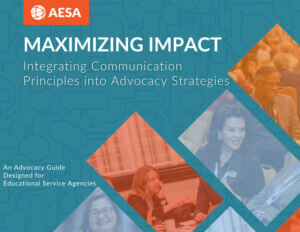 Educational Service Agencies play a critical role in supporting schools and districts, yet their unique needs and challenges often require tailored advocacy approaches. The recently released AESA Advocacy Guide recognizes the distinct position of ESAs and offers targeted strategies to help you navigate the complex landscape of education policy and funding.
Key Features of the toolkit include:
- Audience Analysis
- Message Development
- Channels & Content
- Advocacy Tactics
Advocacy is essential for ensuring that ESAs receive the support and recognition they deserve. With this specialized Advocacy Guide, you’re equipped to lead impactful advocacy efforts that can make a real difference. Download your copy today and take the first step towards stronger, more effective advocacy for your ESA.
SHARE YOUR ADVOCACY SUCCESS STORIES
AESA would like to highlight successful state-level advocacy campaigns. Share your triumphs in state advocacy with fellow members! Contribute to our newsletter by submitting your success stories – your experiences can enlighten and inspire others in navigating the often complex landscape of state advocacy. Together, we can amplify our collective knowledge for the benefit of the entire AESA membership. Send your stories to jwade@aesa.us.
STAY CONNECTED & INVOLVED
Have feedback for the AESA State Advocacy Team? Would you like to see a particular issue area addressed in future editions? Send feedback to jwade@aesa.us.