June 2026: AESA State Examiner
July 1, 2026
Each month, the State Examiner covers five topics including:
- Legislative Issue Monitoring
- Statehouse News: Education Policy (with links to news items)
- State Budget and Finance Monitoring
- National Reports Impacting Education
- Advocacy Tips
Each topic includes a brief introduction. To read the full articles under each headline, click on the "+" sign next to the topic. Please find the pdf for readers who prefer to print a version of the June 2026 State Examiner.
Legislative Issue Monitoring
In each edition of the State Examiner, AESA monitors state-level legislation and legislative trends impacting educational service agencies and their client schools and districts. This month’s report for June 2026 examines trending state policy and funding issues heading into the November 2026 election cycle.

With Summer recess in full swing and the November general elections a few months away, it is a good time to pause, reflect and take stock in what has advanced legislatively in state capitols across the U.S. and what is likely to be front and center on the dockets in the remaining months of the 2026 legislative sessions. State education politics in 2026 are being driven by a mix of fiscal pressure, student outcome concerns, and election-year messaging. Across governors’ addresses, state budget debates, and legislative tracking, a handful of key issues stand out as the ones Educational Service Agencies and education advocates should watch most closely this fall.
First, academic recovery has shifted into a literacy-and-results agenda. Education Commission of the States reports that academic supports and achievement were the most frequently mentioned education issue in 2026 State of the State addresses, with governors in at least 35 states highlighting literacy, science of reading, math improvement, graduation rates, and closing achievement gaps. That matters for ESA leaders because states are increasingly connecting funding and policy decisions to evidence of student growth, reading performance, intervention capacity, and implementation support for districts.
Second, school funding is entering a harder phase. Pew reports that states are now dealing with the end of ESSER relief, slower tax revenue growth, stagnant or declining enrollment, and rising costs tied to staffing, technology, and student needs. Governors continue to talk about record investments and fully funded budgets, but the next round of budget work is likely to focus less on one-time spending and more on affordability, formula redesign, and proof that dollars are reaching high-need students effectively. Congressional changes to Medicaid, which alter the relationship with the states, could also substantially impact state budgets in the coming years as states should more of the burden in the delivery of critical safety net services.
For ESA stakeholders, this means watching three connected finance debates. One is whether states revise foundation formulas or weighted funding systems to better reflect poverty, disability, multilingual learners, transportation, and small-district cost pressures. Another is how states respond to enrollment decline and the expiration of hold-harmless policies that had temporarily protected districts from funding losses. A third is the growing tension between support for public systems and the cost of expanding vouchers, tax-credit scholarships, and education savings accounts.
Third, school choice and ESAs remain a major statehouse flashpoint. Pew found that 12 states recently enacted universal private-school choice eligibility and that at least 25 states have passed new private-school choice laws since 2022. As those programs mature, lawmakers are no longer debating only ideology; they are also debating price tags, participation growth, oversight, and the fiscal effect on public schools and state budgets.
This issue deserves close monitoring in campaign season because school choice continues to poll as a strong political message around parent control, customization, and dissatisfaction with traditional systems. At the same time, the budget consequences are becoming harder to ignore, especially in states trying to manage formula changes, special education costs, or broader structural deficits. ESA leaders should be prepared for renewed questions about service delivery, regional equity, rural access, and how public systems can demonstrate value when choice proposals dominate headlines.
Fourth, teacher workforce pressures are evolving, not disappearing. ECS found that at least 25 governors addressed teacher recruitment, retention, compensation, certification pathways, or educator supports in their 2026 speeches. While shortages are no longer always framed as a crisis headline, states are still pursuing salary increases, housing support, vacancy grants, retirement changes, and alternative pathways to stabilize staffing.
For ESAs, the policy opportunity is practical. Regional service agencies are often the organizations best positioned to help districts with shared staffing pipelines, licensure support, induction, professional development, substitute systems, coaching, and special education personnel recruitment. As budgets tighten, state leaders may increasingly look for regional strategies that stretch scarce talent across districts rather than district-by-district solutions.
Fifth, career pathways and workforce alignment remain politically durable. Governors in at least 31 states and territories highlighted career and technical education, apprenticeships, dual credit, and other school-to-work strategies in 2026 addresses. This is one of the few education areas that consistently attracts bipartisan interest because it connects education spending to visible labor market needs and economic development goals.
That matters in legislative sessions and campaigns alike. Candidates and governors are using workforce language to argue that schools should prepare students for high-demand jobs, credentials, and postsecondary options with clearer economic payoff. ESA leaders should watch for bills and budget items related to regional career centers, employer partnerships, transportation for access to programs, industry-recognized credentials, and cross-district coordination of pathway offerings.
Sixth, student supports now include behavior, well-being, and technology rules. ECS’s 2026 review found that academic supports and student supports rose to the top of governors’ education agendas. In legislatures, that broader student-support frame increasingly includes school climate, discipline, attendance, mental health, tutoring, and rules on student cellphone use during the school day.
Cellphone restrictions are especially worth tracking because they are moving from local practice to state policy. NCSL notes that states have enacted or proposed measures requiring school policies that prohibit or limit student cellphone use during school hours, reflecting concerns about distraction, behavior, cyberbullying, and teacher morale. For ESA leaders, these debates can quickly expand into broader expectations around attendance, discipline consistency, student engagement, and parent communication.
Seventh, artificial intelligence is moving from curiosity to governance. State legislatures are no longer treating AI in schools as a future issue. A report by MultiState related that, as of March 2026, 134 AI-in-education bills had been introduced across 31 states, with major themes including student data privacy, local policy requirements, limits on high-stakes AI use, educator oversight, and AI literacy expectations. Education Week similarly reported growing state attention to AI guidance, literacy, and restrictions on specific uses.
This issue is especially important for ESAs because regional agencies may become the practical bridge between state policy and district implementation. Districts will need help with procurement review, privacy standards, acceptable-use policies, staff training, parent communication, and guardrails that keep humans responsible for grading, discipline, special education decisions, and other high-stakes actions. In many states, the first question will not be whether AI is allowed, but who will help districts use it safely and consistently.
What ESA leaders should monitor now
From now through November, ESA leaders and advocates should focus on several signals. Watch whether legislative leaders and candidates frame education primarily around reading and math results, school choice, affordability, public school accountability, workforce pathways, or culture-and-control issues such as phones, discipline, and parent rights. Watch budget documents for changes in formula factors, special education aid, transportation, early literacy funding, CTE expansion, and any effort to shift dollars toward nonpublic options. And, importantly, monitor the interplay of federal actions on state budgets including, but not limited to, changes in the One Big Beautiful Bill around Medicaid which will put strain on state GRF budgets.
Also watch for the operational side of policy. Bills that sound narrow can carry large implementation demands for districts and service agencies, especially in AI governance, literacy coaching, educator workforce systems, data reporting, and student support mandates. The strongest advocacy position for ESAs this fall will be to show how regional infrastructure helps states move from promises to results: shared expertise, economies of scale, faster implementation, and more equitable access for small and rural districts.
Bottom Line
The broad message for Fall 2026 is clear. States are entering an era where leaders still want visible education gains, but they want them under tighter fiscal conditions and under sharper political scrutiny. For ESAs and allied advocates, the winning strategy is to stay focused on implementation, equity, and cost-effective regional solutions in the areas most likely to shape the next wave of state action: literacy and achievement, school funding formulas, school choice, teacher workforce, career pathways, and governance of student supports and AI.
State Budget and Finance Monitoring
AESA monitors state level budget and finance news impacting preschool and primary and secondary education. These curated articles (with links) can provide insights into what is happening in your state and collectively across the U.S. The latest state budget and finance-related news for June 2026 follows below.
June 2026 saw intense activity across state capitols as governors and legislatures raced to finalize fiscal year 2027 budgets against a backdrop of softening tax revenues, rising costs, and growing pressure to provide property tax relief to homeowners. Several states — including Nebraska, Colorado, and North Carolina — faced structural budget gaps, while others like New Jersey, Florida, and Pennsylvania were engaged in last-minute negotiations to close budget deals before June 30 deadlines. The intersection of state tax policy and education funding was a defining tension of the month, with property tax overhauls in Iowa, Florida, and Maine creating direct ripple effects on school finance. See the following article for greater detail on these finance and tax policy related issues:
Iowa's Property Tax Overhaul Is Creating New Problems for Schools
Governing
Maine's Property Tax Revolt Collides with Reality of Rising School Budgets
The Maine Monitor
Ron DeSantis Signs New Florida Property Tax Law — Here's What to Know
Florida Office of the Governor
Louisiana Lawmakers Approve Jeff Landry Plan to Cut School Budgets to Fund Teacher Stipends
Louisiana Radio Network
Newsom Rejects Scaled-Back Billionaires Tax as Ballot Fight Looms
Washington Examiner
Colorado State Budget Picture Improves — But Not Enough to Reverse Cuts to Public Services
Colorado Sun
What Happens If North Carolina Does Not Pass a New Budget by the June 30 Deadline?
WLOS
NJ budget committees approve $60.7B budget in late-night votes
NY Monitor
Virginia Localities Raise $119M for School Construction Through Targeted Sales Tax
Virginia Mercury
Illinois Set to Tax Social Media Companies
Pluribus News
Nebraska's Projected Budget Deficit Exceeds $170 Million Following New Tax Receipts
Nebraska Examiner
NJ Lawmakers Aim to Bring 'Clarity' to School Budgeting with New Bill
Yahoo News
Key Takeaways for ESAs:
The wave of state property tax relief legislation — popular with voters but costly to local governments and school districts — is emerging as a significant and underappreciated threat to K-12 education funding stability heading into FY2027 and beyond. Revenue shortfalls in multiple states are forcing difficult tradeoffs between tax relief, education investment, and basic public services, with school budgets frequently caught in the middle. For ESAs, monitoring these state fiscal trends is essential, as budget-stressed districts increasingly depend on regional service providers to maintain program quality while absorbing funding cuts.
Statehouse News: Education Policy
Each month AESA finds representative examples (with links) of news items coming out of the states or impacting the states that may be of interest to ESAs and their client schools and districts:
June 2026 marked an inflection point for K-12 education policy at the federal level, as the Trump administration accelerated its effort to dismantle the U.S. Department of Education through a series of interagency agreements transferring special education, civil rights enforcement, and other core functions to HHS and the DOJ. At the same time, states are grappling with converging pressures — declining student enrollment, constrained school budgets, and rapidly shifting federal oversight structures — that directly affect how services are delivered to students, especially those with disabilities. For educational service agencies, these developments represent both significant operational risk and a potential opportunity to demonstrate the irreplaceable value of regional service delivery. The following articles provide greater insight into these issues:
Enrollment Declines Could Cost States $11.5B Annually by 2030-31, Analysis Says
K12Dive
Indiana Becomes the Latest State to Receive Flexibility from Trump on Federal Education Spending
PBS News
Building Future-Proof Workforce Pathways Through Responsive Data Systems
Education Commission of the States
How Alaska Brings Indigenous Culture and Community in the Classroo
Education Commission of the States
How Maryland's Governor Is Tackling Education Challenges
K12Dive
Screen Time Concerns Drive Policy Moves
K12Dive
West Virginia Lawmakers Begin Taking Testimony on Funding Formula Issues
WV Metro News
OhioSEE Program Is Providing Glasses to Students in About 230 School Districts in 15 Counties
Ohio Capital Journal
Vermont Legislature's Sweeping Education Reform Bill Becomes Law
Vermont Public
MI Education Leaders Working on New Special Education Initiative
WILX
Teacher Collaboration and Student Outcomes in Texas
Education Commission of the States
Ed Dept Addresses 'Misconceptions' About Special Education Outsourcing
K12Dive
Education Department Transfers Key Special Ed, Civil Rights Functions
K12Dive
Splitting Up Special Ed and Civil Rights Will Dilute Services, Experts Say
The 74
Special Education Faces Two Big Changes. But the Constant Budget Crunch Isn't Going Anywhere.
Idaho Ed News
The Education Dept. Now Has 14 Interagency Agreements. Here Are the Changes.
K12 Dive
Democrats Move to Impeach McMahon for Education Department Dismantling
The 74
What Will the Justice Department OCR Agreement Mean for Schools
K12 Dive
Population Growth Slowed Across Most States in 2025
Governing
Educators testify against a bill that would ban diversity and inclusion efforts in Ohio K-12 schools
Ohio Capital Journal
Key Takeaways for ESAs:
The federal restructuring of special education oversight creates immediate uncertainty for ESAs regarding grant administration, compliance monitoring, and technical assistance pipelines that have historically flowed through the Department of Education's OSERS. Simultaneously, enrollment-driven revenue losses and state budget pressures are increasing the likelihood that districts will turn to ESAs for cost-effective shared services — making ESA advocacy and visibility more critical than ever. The E-rate threat, court challenges to federal education rules, and growing state-level policy variation further underscore the need for ESAs to stay closely engaged in both federal and state legislative developments.
National Reports Impacting Education
AESA monitors state and national reports and policy briefs highlighting state-level information of interest to ESAs. As always, it is important to view these reports through a critical lens with attention to research design, methodology, data sources and citations, peer review, and publication venue. This month AESA spotlights reports and policy briefs from researchers at Education Commission of the States and the Annie E. Casey Foundation.
The number and percentage of students receiving special education services in schools has increased since 2000, and this trend has continued in recent years even as overall student enrollment has declined. This updated Education Commission of the States policy guide highlights trends in special education enrollment across the country and state strategies that can more equitably fund and support high-quality services for students. States trying to improve special education services can consider the following four approaches:
- Identify special education costs in the state.
- Differentiate funding based on need.
- Develop recruitment and retention initiatives.
- Strengthen regional support for districts.
Access the document here.
KIDS COUNT® indicators capture what children and youth need most across four domains:
- Economic Well-Being
- Education
- Health
- Family and Community
Each domain includes four indicators for a total of 16. New this year, the enhanced KIDS COUNT index includes both rankings and scores, offering a more complete picture of child well-being. While rankings show how states compare with one another, scores (ranging from 0 to 1,000) show how far apart states are and offer a way to track progress since 2019 — the last full year before the pandemic. Because state policies and conditions shape children’s opportunities, a child’s future still depends in large part on where they grow up. The report provides state-by-state data and rankings. Access the report here.
These reports offer ESAs timely, actionable data on both the rising demand for special education services and the broader context of child well being that shapes students’ needs and district priorities. By highlighting state level trends in special education enrollment and funding strategies, the ECS guide reinforces the critical role of regional agencies in equitable finance, shared services and recruitment/retention initiatives. At the same time, the KIDS COUNT Data Book’s enhanced index and state by state scores give ESAs a concise, comparable picture of how children are faring across economic, education, health, and family/community domains since the pandemic, helping them target supports, frame advocacy, and align regional initiatives with the conditions children actually face in their states.
Advocacy Tip
Educational service agencies (ESAs) and their state associations are under growing pressure to speak clearly on policy, protect public trust, and build lasting support for their work. The right legal structure can help them educate lawmakers, engage members, raise funds, and, in some cases, do more direct advocacy than a traditional charity can do on its own.
For many ESA leaders, the real question is not whether to do advocacy. The question is how to organize advocacy in a way that fits the mission, the funding model, and the rules. Nationally, the main federal tax models worth considering are 501(c)(3), 501(c)(6), and 501(c)(4), along with related affiliated-entity models that combine more than one type of organization.
 Why structure matters
 Why structure matters
A legal structure shapes what an organization can do (and can’t do), how it can raise money, and how much risk it takes on. It affects whether donations are tax-deductible, how much lobbying is allowed, whether candidate-related activity is permitted, and how carefully an affiliated network must separate staff time, money, and messaging.
That matters for ESAs because their work often sits at the intersection of public service, technical assistance, professional learning, school improvement, and public policy. A structure that works well for training and research may be too limited for a stronger legislative agenda, while a structure built for aggressive advocacy may not be the best home for grant-funded educational work. Nothing can derail an advocacy effort faster than controversy or a lack of trust and integrity; getting it right on the front end is important.
The 501(c)(3) model
A 501(c)(3) public charity is often the most familiar model in the education space. It works well for research, professional development, technical assistance, public education, issue briefs, conferences, demonstration projects, and other charitable or educational work.
A 501(c)(3) may do advocacy and may do some lobbying, but lobbying cannot become too large a share of its work unless the organization follows the 501(h) expenditure test. It is absolutely barred from supporting or opposing candidates for public office.
For ESAs and state ESA associations, the 501(c)(3) model is often the strongest fit when the main goal is to build credibility, produce trusted information, and attract foundation or charitable support. It is usually the best starting point if the organization wants to be seen first as an educational or charitable institution rather than as a political actor.
Still, ESA leaders should not assume that a 501(c)(3) must stay silent. Under federal tax rules, a charity can testify, meet with lawmakers, share policy analysis, comment on proposed regulations, and support or oppose specific bills within the applicable limits.
Practical strengths of a 501(c)(3)
- Tax-deductible charitable gifts can support the work.
- The model fits education, research, and capacity-building functions well.
- It carries strong public legitimacy with schools, government agencies, and philanthropy.
- It still allows meaningful advocacy if leaders understand the rules and track activity carefully.
Main limits of a 501(c)(3)
- Candidate campaign intervention is prohibited.
- Lobbying is limited, either under the substantial part test or the 501(h) expenditure test.
- Leaders must invest in tracking staff time, consultant costs, and communication expenses tied to lobbying.
The 501(c)(6) model
A 501(c)(6) is a business league or similar membership organization that exists to improve the business conditions of a line of business, profession, or trade. For some statewide ESA associations, this model may be worth considering when the organization functions more like a member-driven trade or professional association than a charity
The main advantage is advocacy flexibility. A 501(c)(6) may generally do unlimited lobbying related to its exempt purpose, although it must address tax and notice rules tied to dues used for lobbying or political activity.
This model can make sense where the state association’s main purpose is to represent ESA members, influence policy, and strengthen the operating environment for the field. If the association is chiefly a membership voice for ESA leaders and regional agencies, a 501(c)(6) may fit that role better than a 501(c)(3).
But there are trade-offs. Contributions to a 501(c)(6) are generally not charitable donations, and the model is not always as attractive for foundation funding or public-facing educational initiatives. It also raises governance questions if the association is closely tied to public entities that must preserve public trust and avoid using public resources for partisan purposes.
Practical strengths of a 501(c)(6)
- Stronger lobbying capacity than a 501(c)(3).
- Good fit for a dues-based member association.
- Well suited for field representation, policy platforms, and sector-wide advocacy.
Main limits of a 501(c)(6)
- Donations are generally not tax-deductible as charitable gifts.
- The structure may be less helpful for grant-funded educational work.
- It requires careful member-dues disclosures when dues support lobbying or political activity.
The 501(c)(4) model
A 501(c)(4) social welfare organization is built for promoting the common good and general welfare of a community. It may engage in unlimited lobbying related to its social welfare purpose and may participate in some political campaign activity, so long as campaign activity is not its primary activity.
For ESAs and state networks, a 501(c)(4) is usually not the first structure to choose by itself. It can, however, be useful as an affiliate when leaders want a more assertive advocacy arm that can do stronger lobbying, broader grassroots mobilization, or some issue-election work that a 501(c)(3) cannot do.
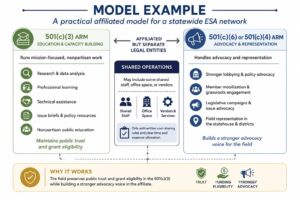
This model is often most realistic for a statewide network that already has a solid 501(c)(3) education and research arm but wants a separate advocacy vehicle. In that setup, the 501(c)(4) handles the harder-edge advocacy work, while the 501(c)(3) continues charitable and educational functions.
The caution is simple but serious: a 501(c)(3) and a 501(c)(4) must be kept truly separate. They may share some staff or office resources, but they must separately incorporate, maintain separate finances, document cost sharing, and make sure the charity is not subsidizing the c(4)’s non-charitable or political activities.
Practical strengths of a 501(c)(4)
- Unlimited lobbying tied to social welfare purposes.
- Greater flexibility for public advocacy campaigns than a 501(c)(3).
- Useful as part of an affiliated structure when a field wants both education and stronger advocacy
Main limits of a 501(c)(4)
- Contributions are generally not tax-deductible as charitable gifts.
- Candidate-related activity cannot become the organization’s primary activity.
- Strong separation rules are needed if it is affiliated with a 501(c)(3).
Other models worth considering
Some ESA systems may not need a new tax-exempt entity at all. In some states, ESAs are public or quasi-public bodies, and their state network functions through intergovernmental agreements, fiscal agents, or membership arrangements rather than through a separate nonprofit corporation. In those cases, leaders should examine state law, public ethics rules, procurement rules, and election rules before copying a nonprofit model.
Another option is the affiliated-entity model. A statewide network may use a 501(c)(3) for research, training, and charitable work, while a separate 501(c)(6) or 501(c)(4) handles more aggressive lobbying or member representation. This can give the field the best of both worlds, but it only works if governance, accounting, branding, staffing, and cost allocation are handled with discipline.
In some settings, a taxable entity may also be worth discussing for revenue-generating services that do not fit neatly inside a charity or membership association. That choice is less about advocacy and more about risk management, earned income, and organizational clarity, so it should be reviewed carefully with legal and tax counsel.
Choosing a model for ESAs
There is no single right answer for every state. The best model depends on what the organization is mainly trying to do. If the main goal is public education, professional learning, grant-supported work, and trusted policy analysis, the 501(c)(3) model is often the best fit. If the main goal is sector representation and direct lobbying on behalf of members, a 501(c)(6) may be more practical. If leaders want a separate advocacy arm that can lobby without charitable limits and do some political work, an affiliated 501(c)(4) may deserve review.
The more public money, public authority, or public staffing involved, the more careful leaders must be. Many ESA networks operate close to state agencies, school districts, or regional public bodies. That means public-sector ethics, use-of-resource rules, and public trust concerns may matter just as much as federal tax status.
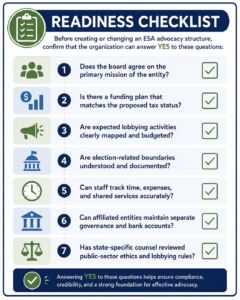
Governance questions to ask first
Before recommending any structure, ESA leaders and board members should slow down and ask a few direct questions.
- What is the main mission: education, member representation, advocacy, or a mix?
- Who will fund the work: dues, grants, contracts, charitable gifts, or earned revenue?
- How much direct lobbying does the organization expect to do in a typical year?
- Does the organization want to stay fully nonpartisan, or is there interest in a separate advocacy vehicle with greater flexibility?
- Are the members public entities, nonprofit agencies, or a mix of both?
- Can the organization truly keep separate books, boards, bank accounts, and staff allocations if it uses an affiliated model?
These questions often point to the answer faster than abstract legal debate. They help leaders match the structure to the mission instead of forcing the mission into the wrong structure.
A practical path forward
For many statewide ESA networks, the most durable path is phased rather than immediate. Start with the function that is clearest and most defensible, then build outward.
A common path is to use a 501(c)(3) or similar charitable structure for educational work, adopt strong advocacy tracking systems, and make the 501(h) election if that fits the organization. If lobbying needs grow beyond what leaders find comfortable in a charity, the network can then evaluate a separate affiliated entity instead of stretching the original organization beyond its best use.
The key is not to chase the most powerful-sounding structure. The key is to choose the structure that the board can govern well, staff can administer cleanly, and members can explain with confidence to lawmakers, funders, and the public.
Disclaimer and resources
This article is offered for general educational purposes only. It is not legal advice, tax advice, or a substitute for state-specific counsel. ESA leaders should consult qualified legal and tax advisors before choosing a structure, launching an affiliate, or starting a new lobbying or election-related activity.
Resource links
- IRS: Lobbying
- IRS: Measuring lobbying activity: Expenditure test
- IRS: Restriction of political campaign intervention by section 501(c)(3) organizations
- IRS: Social welfare organizations
- IRS: Political activity and social welfare
- IRS: Business leagues
This article is intended for educational and informational purposes and does not constitute legal advice. ESA leaders and their associations should always consult with qualified legal counsel regarding the campaign finance laws applicable in their specific states before engaging in any campaign finance activity. State laws vary significantly and change frequently.
AESA State Advocacy Resources for ESAs
State-level legislative advocacy plays a crucial role in shaping the educational landscape. While federal policies often set broad educational priorities, state legislatures hold significant power over the funding, governance, and standards that directly impact local schools and districts. AESA supports state-level advocacy by offering training through publications, workshops, and presentations, which can be customized for individual states.
AESA empowers education leaders to become effective advocates through its customized advocacy trainings, designed to meet a variety of needs and schedules. Whether you’re seeking an in-depth exploration or a concise overview, AESA offers three levels of workshops to build your legislative knowledge and confidence:
-
Three-Day Workshop: A comprehensive, step-by-step immersion into state advocacy. Participants gain a strong understanding of the legislative landscape, policy-making, and practical advocacy strategies.
-
One-Day Workshop: A focused format that delivers essential advocacy skills and actionable takeaways for leaders short on time.
-
One-Hour Presentation: Perfect for regional or local events, these expert-led sessions address state-specific challenges in politics, school finance, and education policy.
Need something unique? AESA can tailor a training to your goals, schedule, and audience. Every session is designed to build legislative knowledge, sharpen messaging, and empower participants to drive change at the state level.
Please contact Joan Wade, AESA Executive Director, for more information.
 Educational Service Agencies play a critical role in supporting schools and districts, yet their unique needs and challenges often require tailored advocacy approaches. The recently released AESA Advocacy Guide recognizes the distinct position of ESAs and offers targeted strategies to help you navigate the complex landscape of education policy and funding.
Key Features of the toolkit include:
- Audience Analysis
- Message Development
- Channels & Content
- Advocacy Tactics
Advocacy is essential for ensuring that ESAs receive the support and recognition they deserve. With this specialized Advocacy Guide, you’re equipped to lead impactful advocacy efforts that can make a real difference. Download your copy today and take the first step towards stronger, more effective advocacy for your ESA.
SHARE YOUR ADVOCACY SUCCESS STORIES
AESA would like to highlight successful state-level advocacy campaigns. Share your triumphs in state advocacy with fellow members! Contribute to our newsletter by submitting your success stories – your experiences can enlighten and inspire others in navigating the often complex landscape of state advocacy. Together, we can amplify our collective knowledge for the benefit of the entire AESA membership. Send your stories to jwade@aesa.us.
STAY CONNECTED & INVOLVED
Have feedback for the AESA State Advocacy Team? Would you like to see a particular issue area addressed in future editions? Send feedback to jwade@aesa.us.