January 2026: AESA State Examiner
February 2, 2026
Each month, the State Examiner covers five topics including:
- Legislative Issue Monitoring
- Statehouse News: Education Policy (with links to news items)
- State Budget and Finance Monitoring
- National Reports Impacting Education
- Advocacy Tips
Each topic includes a brief introduction. To read the full articles under each headline, click on the "+" sign next to the topic. Please find the pdf for readers who prefer to print a version of the January 2026 State Examiner.
Legislative Issue Monitoring
In each edition of the State Examiner, AESA monitors state-level legislation and legislative trends impacting educational service agencies and their client schools and districts. This month’s report for January 2026 examines state activity related to school district consolidation and regionalization.
State legislatures across the country are confronting an unprecedented convergence of fiscal pressures, property tax revolt and student enrollment decline that have put school district consolidation and regionalization back into the policy spotlight.
The expiration of $189 billion in federal Elementary and Secondary School Emergency Relief (ESSER) funds in September 2024, combined with sustained enrollment declines affecting nearly 70 percent of districts nationwide, has created what budget analysts describe as a "fiscal cliff.” These immediate budget constraints are compounded by demographic headwinds—declining birth rates, the expansion of school choice and voucher programs, and housing cost pressures forcing young families to relocate.
These, of course, are not new conversations. And the political dynamics surrounding consolidation remain complex and contentious. While fiscal realities make efficiency arguments increasingly compelling, consolidation efforts inevitably trigger fierce debates about local control, community identity, equity, and the preservation of rural schools that serve as economic and social anchors for small towns.
Some states are pursuing mandatory consolidation through legislative action, others are offering financial incentives to encourage voluntary mergers, and still others are exploring regional shared services models that preserve district autonomy while achieving economies of scale. Against this backdrop, the role of Educational Service Agencies (ESAs) as neutral conveners, shared service providers, and implementation partners positions these intermediate organizations at the center of an evolving state education landscape. Outlined below is a review of some of the leading state-level policy discussions across the United States.
State-Level Consolidation Activity
- Wisconsin - Wisconsin legislators have introduced an aggressive consolidation incentive package responding to projections that the state's population will decline by 200,000 residents by 2050 and that 70 percent of the state's 421 school districts have experienced enrollment declines, totaling 53,000 fewer students since the 2013-14 school year. Senate Bill 656 and companion legislation, introduced in November 2025, would increase per-pupil consolidation payments for districts that complete mergers during a three-year window covering 2026, 2027, or 2028. The proposal includes multiple consolidation pathways. Beyond full district mergers, the legislation proposes a "whole grade sharing" option that would provide per pupil funding annually for up to four years to districts that agree to pool students by grade level without fully consolidating operations. Feasibility study reimbursements would also be available to support districts exploring either merger or grade-sharing arrangements. Another measure mandates a comprehensive statewide study of school district boundaries to identify future consolidation opportunities "before the state is forced to mandate it during a crisis."
- Vermont - Vermont's Act 73, passed in June 2025, represents a comprehensive and prescriptive consolidation mandate, requiring the Legislature to redraw school district boundaries during the 2026 session to reduce the state's current 119 school districts and 52 supervisory unions. The legislation ties this structural consolidation directly to the implementation of a foundation funding formula, with new districts becoming operational by July 1, 2029. Governor Phil Scott's administration has projected annual savings of approximately $180 million if consolidation proceeds as planned—a significant amount in a state where per-pupil costs have reached among the highest in the nation and property taxes have become a political flashpoint. Act 73's mandatory approach has generated fierce opposition and faces an uncertain legislative future. The Redistricting Task Force created by the law voted 8-3 in November 2025 to recommend a voluntary approach centered on five cooperative service areas modeled after New York's Boards of Cooperative Educational Services (BOCES), explicitly rejecting forced mergers in favor of shared services arrangements. Task Force members pointed to limited evidence that consolidation generates sustained cost savings, citing a 2024 study of Act 46—Vermont's 2015 consolidation law—that found previous district mergers produced only minimal savings.
- Pennsylvania - A Pennsylvania consolidation proposal centers not on immediate legislative mandates but on comprehensive studies examining whether the Commonwealth's number of school districts should be further reduced. House Resolution 377 directs the Legislative Budget and Finance Committee to study the reorganization and consolidation of districts. The resolution frames consolidation as both a fiscal efficiency measure to reduce administrative costs and an equity interventio Pennsylvania's 27 Intermediate Units (IUs) already provide an extensive shared services infrastructure, and the Pennsylvania Department of Education leverages contractual relationships with these IUs to implement school improvement cycles for underperforming schools. The dual-track approach of study commissions examining consolidation while maintaining robust regional service agencies suggests Pennsylvania policymakers may be hedging between structural reorganization and enhanced shared services as efficiency strategies.
- Ohio - The consolidation debate in Ohio has gained momentum inside of broader property tax reform conversations that have local and state officials scrutinizing the number of local political subdivisions in the state including school districts. A few government efficiency bills have been introduced in the Buckeye State. House Bill 454 would create the State Government Efficiency Commission to review state government services and eliminate duplicative and overlapping functions within state departments. This would indirectly impact local political subdivisions often tasked with implementing state agency work. Another bill, House Bill 574, would create the Political Subdivision Consolidation Incentive Grant pilot. If passed, this grant program would appropriate $25 million through the Ohio Secretary of State’s Office. Awards would be made on a first-come, first-serve basis, post-merger to eligible political subdivisions. Priority appears to be placed on municipalities and townships, though school districts and ESCs would be eligible. While no comprehensive school district consolidation legislation has been introduced yet, it is important to note that existing state law already mandates shared services by school districts requiring all districts with enrollment of 16,000 or fewer students to align to and enter service agreements with an Educational Service Center (ESC) of their choice—a mandate that applies to all but the ten largest districts in Ohio. This requirement positions Ohio's 51 ESCs as essential infrastructure for achieving operational efficiencies without formal district consolidation.
- New York - New York's 2025 legislative session has produced opposing consolidation bills that illustrate a stark policy divide on district structure. S4171 would direct the Commissioner of Education to establish a county-based system creating exactly 62 school districts—one per county—consolidating what are currently hundreds of districts across the state. In contrast, S589—titled the "Our Schools Our Rules Act"—would explicitly prohibit any state-mandated regionalization plans, blocking the State Education Department and Board of Regents from requiring districts to share resources, operations, or services. The bill emerged directly in response to the State Education Department's regionalization initiative launched in 2024 (outlined below), which initially required all BOCES component districts to participate in regional planning processes—a mandate the Board of Regents subsequently made voluntary in December 2024 after receiving public backlash. S3313, meanwhile, takes a middle path, extending the tax phase-in period for voluntary consolidations from 10 to 20 years to ease the property tax transition and make mergers more politically palatable to voters in affected districts. These competing bills reflect fundamental disagreements about whether New York's district structure can be reformed through top-down mandate or must rely on bottom-up voluntary action supported by financial incentives. As referenced above, the State Education Department launched a comprehensive regionalization initiative in 2024 that positions BOCES District Superintendents as conveners and facilitators of regional educational planning. The initiative asks school districts throughout the state to work with their BOCES District Superintendents to develop regional plans identifying solutions to academic and operational challenges. The initiative reflects a middle path: rather than imposing consolidation or simply maintaining the status quo, New York is leveraging its existing BOCES infrastructure to facilitate bottom-up regional collaboration while creating accountability mechanisms (voluntary plans reviewed by the State Education Department) that could inform future policy decisions.
- New Jersey - New Jersey's approach emphasizes feasibility studies and voluntary action rather than mandates. Senate Bill 3488, signed into law in January 2022, established the School Regionalization Efficiency Program (SREP), which reimburses districts 50 percent of feasibility study costs upfront and the remaining 50 percent upon study acceptance by the New Jersey Department of Education. Critically, the law specifies that districts commissioning studies are not obligated to proceed with consolidation, and studies that find regionalization would increase costs, create inefficiencies, or enhance segregation cannot move forward. The state's Department of Community Affairs continues accepting SREP grant applications, with priority given to K-12 regionalization proposals and countywide school district plans.
Bottom Line and Opportunities for Educational Service Agencies
State fiscal pressures, declining enrollment, expanded school choice, and revenue‑per‑pupil funding formulas are converging to drive a new wave of school district consolidation and regionalization. These forces are reshaping the operating environment for districts and elevating the strategic importance of ESAs as states seek greater efficiency without sacrificing educational access or quality.
ESAs occupy a critical position in this landscape, with the capacity to act as conveners, capacity‑builders, and shared service providers regardless of whether states pursue full district consolidation, enhanced regional cooperation, or maintenance of existing structures.
Perhaps the most significant opportunity for ESAs lies in expanding shared services that achieve economies of scale without eliminating district boundaries, an approach often more politically feasible where community resistance to consolidation is strong. Research and field experience indicate that ESAs frequently deliver services more cost‑effectively than individual districts by aggregating demand and centralizing expertise.
As consolidation debates intensify, ESAs must deliberately position themselves as indispensable partners rather than threatened intermediaries. The school district consolidation wave represents both a fundamental challenge and a strategic opportunity for ESAs. Three scenarios present distinct implications:
- In states pursuing mandatory district consolidation (Vermont, potentially New York, Mississippi under study), ESAs must position themselves as essential implementation partners providing transition management, shared service coordination, and capacity-building for newly enlarged districts that will face unprecedented operational complexity.
- In states offering financial incentives for voluntary consolidation (Wisconsin, New Jersey, Pennsylvania), ESAs can serve as neutral conveners, facilitating merger discussions and providing feasibility analysis while simultaneously offering shared services as a less disruptive alternative to full consolidation.
- In states maintaining existing district structures while enhancing regional cooperation (Ohio, New York's regionalization initiative), ESAs become the primary vehicle for achieving efficiency gains through expanded shared services, cooperative purchasing, and back-office consolidation.
The moment demands strategic vision, proactive engagement, and demonstrated value to position regional shared services as an essential component of state efficiency and equity strategies.
State Budget and Finance Monitoring
AESA monitors state level budget and finance news impacting preschool and primary and secondary education. These curated articles (with links) can provide insights into what is happening in your state and collectively across the U.S. The latest state budget and finance-related news for January 2026 follows below.
State Budget Stress Intensifies in 2026
Governing
Mounting Pressures Usher in a New Budget Era
Pew
5 State Fiscal Debates to Watch
Pew
Lawmakers Across the Country Are Scrambling to Cut Property Taxes. Here’s Why
The News Tribune
Nebraska Legislature begins 60-day session facing $471 million deficit
KTIV.com
Gov. Phil Scott insists on lawmakers 'keeping our word' on education reform in State of State speech
Vermont Public Radio
Gov. Kelly proposes ‘People’s Budget’ with education funding, water protection focus
WIBW.com
Kemp budget includes tax cuts, $2,000 for teachers and state employees
The Atlanta Journal-Constitution
Nebraska Governor unveils budget proposal with spending cuts across departments
Nebraska Public Media
U.S. Department of Education Approves Iowa’s Returning Education to the States Waiver
U.S. Department of Education
MARESA school districts reject state per pupil funding due to concerns about state budget language
TV6 Michigan
Statehouse News: Education Policy
Each month AESA finds representative examples (with links) of news items coming out of the states or impacting the states that may be of interest to ESAs and their client schools and districts:
The Biggest Issues to Watch in 2026
Governing
Washington County schools partner with ESC after developmental disabilities funding loss
WTAP
Superintendents highlight BOCES, special‑education capacity and school construction needs
Citizen Portal
Saunders proposes education service agency for career and technical education
Rutland Herald
Agency of Education approves Vermont's first BOCES, a resource sharing program for school districts
NBC5 Burlington
$9.7 million awarded to expand access to free pre-K across Michigan
ABC I12 News
New Mexico Senate unanimously advances K-12 math and literacy bills
Source New Mexico
Youth apprenticeship program hosts 6th annual signing day at GCC
The Batavian
‘Blindsided’ by budget cut, Michigan early childhood programs fight to survive
Bridge Michigan
Alaska lawmakers consider strategies to boost attendance as chronic absenteeism persists
States Newsroom
Bipartisan Ohio bill would set income limit for private school vouchers
Dayton Daily News
12 states join Ohio in offering public funding for private schools
Cleveland.com
State lawmakers gear up for AI regulation battles in ‘26
Pluribus News
National Reports Impacting Education
AESA monitors state and national reports and policy briefs highlighting state-level information of interest to ESAs. As always, it is important to view these reports through a critical lens with attention to research design, methodology, data sources and citations, peer review, and publication venue. This month AESA spotlights reports from NASBO, the Education Law Center, the Council of Parent Attorneys and Advocates (COPAA), and Truth in Accounting.
This edition of the NASBO State Expenditure Report includes data from estimated fiscal 2025, actual fiscal 2024, and actual fiscal 2023. The report includes 50-state data broken down by fund source and program area, as well as data from three U.S. territories and the District of Columbia. According to the report, total state spending grew moderately for a fourth consecutive year in estimated fiscal 2025 following record growth in fiscal 2021. While the growth rate in total state spending was similar to that of the past few years, the growth rate in individual funding sources differed from recent trends. From fiscal 2022 to fiscal 2024 state funds grew strongly while federal funds to states declined. To learn more and how individual states are performing, you can access the report here.
In mid-December 2025, Education Law Center released, Making the Grade: How Fair is School Funding in Your State?, the latest contribution to the organization’s decade and a half series of annual reports on school funding fairness. Making the Grade 2025 evaluates each state’s education funding system on three critical measures of fairness:
- Funding Level
- Funding Distribution
- Funding Effort
Over the past decade, private school choice programs have proliferated in the United States, altering the nation’s educational landscape and expanding the schooling options available to many students and their families. The debate over these programs has intensified as well, as the private school choice movement shifted its focus to expanding access for a much different population of students than it did previously, threatening to abandon or sharply curtail its historic focus on providing opportunities to some of our nation’s most disadvantaged students, including those with disabilities and from low-income households. The Council of Parent Attorneys and Advocates (COPAA) has issued the report Private School Choice Programs: Is There a Seat for Students with Disabilities that specifically examines the implications of the rapid expansion of the private school choice movement for students with disabilities. Along with updated analysis, the report offers key findings and makes recommendations to policymakers and parents. Access more information and the report here.
Truth in Accounting’s 2025 Financial State of the States report, its sixteenth annual edition, finds that half of U.S. states still lack enough assets to cover all their bills, despite formal balanced-budget requirements. Using full accrual, “Fact-based” accounting, the report calculates that states collectively hold about 2.2 trillion dollars in assets and 2.9 trillion dollars in debt, leaving an overall shortfall of roughly 765 billion dollars, driven primarily by approximately 832 billion dollars in unfunded pension obligations. Twenty-five “Sunshine States” have a Taxpayer Surplus and twenty-five “Sinkhole States” have a Taxpayer Burden, with smaller, resource-rich states such as North Dakota and Alaska again among the strongest performers. Overall, the report warns that continued reliance on budget maneuvers, underfunded retirement promises, and the waning boost from temporary federal pandemic aid are masking structural imbalances and shifting significant costs to future taxpayers. See how your state ranks here.
Advocacy Tip: Developing an Effective State Legislative Platform
AESA recently convened the association’s Federal Advocacy Committee, which is responsible for reviewing and updating the federal legislative platform and agenda. These consensus-built documents collectively guide the organization’s advocacy efforts at the federal level and provide the direction the advocacy team needs to represent the combined interests of ESAs on Capitol Hill. Individual educational service agencies (ESAs) and statewide networks should engage in this same process at the state level.
For ESAs navigating an increasingly complex (and competitive) state policy and funding landscape, a well-crafted legislative platform isn't just a document—it serves as a strategic tool to organize disparate (and often seemingly siloed) priorities into coherent and unified action. Because executive agencies and state legislatures wield significant power over ESA funding, governance, and operational standards, the question isn't whether your organization or network needs a legislative platform, but rather how effectively you're using one to advance your mission and priorities.
A legislative platform is a formal statement of an organization's positions on key policy issues affecting their work. It can represent the views of a single ESA or a statewide network. Think of it as both a roadmap and a rallying cry: it guides advocacy efforts internally while communicating priorities clearly to legislators, policymakers, media, and the public.
A comprehensive legislative platform presents a cohesive set of priorities that reflects an organization's core values and strategic direction. It answers the fundamental question every legislator asks: "What does your organization stand for?"
The most effective platforms strike a deliberate balance. They're precise enough to state clear positions on specific issues—such as funding formulas, shared services authority, or accountability requirements—yet flexible enough to allow staff the latitude to negotiate and achieve results consistent with the platform's intent. This strategic ambiguity prevents organizations from boxing themselves into unsustainable positions while maintaining principled boundaries for advocacy work.
The benefits of developing a formal legislative platform extend far beyond simply having talking points for the next legislative session.
- Unified Voice and Consistency. When multiple ESA leaders, board members, and staff members engage with legislators, a platform ensures everyone speaks from the same playbook. This consistency builds credibility with policymakers who need to understand—quickly and clearly—where your organization stands on emerging issues.
- Membership Engagement and Buy-in. Grassroots success correlates directly with the number of advocate-legislator relationships you can activate. A platform developed through member input creates natural opportunities for ESA personnel across your state to engage in the process, building ownership and enthusiasm for advocacy work.
- Strategic Focus Amid Competing Demands. State legislative sessions move quickly, with hundreds of bills introduced in compressed timeframes. A well-defined platform helps you prioritize where to invest limited advocacy resources, enabling you to respond strategically and proactively rather than reactively to legislative developments.
The most credible legislative platforms emerge from genuine member input, not top-down pronouncements. Don’t delegate your responsibilities as an advocate; be engaged. Effective models for priority identification often include the following:
- Start With Stakeholder-Generated Issues. Have clients, staff and other key stakeholders propose platform ideas or amendments ensures that priorities reflect actual concerns from the field rather than assumptions about what matters. For ESAs, this might mean soliciting input through regional meetings, surveys, or formal resolution processes at client district or internal staff meetings.
- Create Structured Opportunities for Discussion. Many associations and statewide networks hold regional legislative platform meetings specifically designed to expand involvement by members in the process and provide opportunities for discussion, reactions and input on proposals and amendments. These forums serve dual purposes: they surface diverse perspectives and build consensus before formal votes. This model can be used locally as well.
- Establish a Platform Development Committee. Designate a representative committee to synthesize stakeholder input and develop recommendations. Platform Development committees should reflect geographic, demographic, and operational diversity among ESAs and or client districts to ensure all voices shape the final product.
- Use Data to Inform Priorities. While member experience drives priority identification, supplement grassroots input with objective analysis. Review pending legislation, regulatory proposals, budget trends, and research on ESA challenges. This evidence-based layer strengthens your platform by demonstrating that priorities reflect both lived experience and documented need.
- Apply Strategic Filters. Not every issue merits platform inclusion. Ask: Does this affect multiple ESAs statewide? Can state policy meaningfully address it? Does it align with our core mission? Will legislative action likely occur in the foreseeable future? These filters help distinguish true priorities from worthy but secondary concerns and help organize priorities with an eye towards advancing what is possible given the current context.
Consensus-building requires more than taking votes—it demands structured processes that honor diverse perspectives while moving toward shared positions.
- Establish Clear Ground Rules Early. Successful multi-stakeholder consensus efforts begin with explicit agreements about decision-making processes, roles, and expectations. Will you require simple majority or supermajority approval? How will minority viewpoints be acknowledged? What constitutes sufficient consensus to proceed? Answering these questions before debates begin prevents procedural conflicts from derailing substantive discussions.
- Use Joint Fact-Finding. When ESAs disagree about priorities, disagreements often stem from different understandings of problems rather than fundamentally incompatible values. Develop shared factual foundations about issues.
- Embrace "Near-Consensus" Solutions. Create mechanisms for advancing priorities that have strong but not universal support while documenting dissenting views. This approach respects minority perspectives without allowing small factions to veto widely supported positions.
- Ensure Inclusive Representation. The composition of the platform development process shapes its legitimacy. If large urban ESAs dominate your committee, rural agencies may question whether the platform serves their interests. Intentionally structure participation to reflect your state's ESA diversity—by size, geography, service models, and student populations served.
- Build in Feedback Loops. Consensus isn't always permanent. Create processes for revisiting platform positions as circumstances change, new information emerges, or implementation reveals unintended consequences.
A legislative platform sitting in a filing cabinet serves no one. Effective advocacy requires strategic, sustained communication to key audiences.
- Prioritize Face-to-Face Engagement with Legislators. Despite the convenience of email and social media, research consistently shows that in-person meetings remain "the platinum standard of influence." Despite public perception to the contrary, legislative success is still built on a foundation of relational vs. transactional politics; lasting legislative wins are rarely the result of one-off deals. Schedule statehouse visits, invite legislators to tour ESA facilities, and attend legislative coffees in their districts.
- Target Communications Strategically. Don't blast generic messages statewide. Activate ESA leaders and staff in specific legislative districts to communicate with their representatives about how platform priorities affect local students and communities.
- Engage Multiple Decision-Makers and Influencers. State education policy emerges from interactions among legislators, legislative staff, governor's office education advisors, state education agency leaders, and legislative committee chairs. Your platform communication strategy should systematically reach all these actors. Understand both formal and informal decision-making structures—the ability to influence informally is just as important as engaging formal authority.
- Tell Compelling Stories, Not Just Policy Arguments. Legislators hear abstract policy debates constantly. What breaks through? Personal stories demonstrating real impact. When advocating for increased special education funding, for example, don't just cite dollar amounts—share how a particular intervention produced positive outcomes and how inadequate funding forced an ESA to reduce therapy services to students with disabilities. Stories often motivate more effectively than statistics alone.
- Communicate Clearly and Concisely. Legislators juggle dozens of issues simultaneously. Respect their time with clear, focused messages: identify the specific bill number, state your position explicitly, explain concisely how it affects constituents, and make a specific ask. Never leave a meeting without making the “ask” and knowing if they support, oppose or are neutral on an issue.
- Leverage Coalition Partnerships. Partner organizations amplify your voice. Identify education associations, advocacy groups, and stakeholder organizations that share specific platform priorities. Joint advocacy—co-signed letters, coalition testimony, coordinated member mobilization—demonstrates breadth of support and multiplies your influence. Be strategic. Politics makes for strange bedfellows as the saying goes; sometimes the enemy of your enemy is your friend.
- Build Relationships Before You Need Them. The most effective advocacy happens long before critical votes. Build a relationship and communicate priorities before the legislative session begins. Short sessions require accelerated decision-making; establishing relationships during the interim positions you to influence outcomes when timing is compressed.
- Don't Forget Post-Session Communication. District days, when legislators return home after session, provide valuable opportunities to strengthen relationships, thank supporters, and lay groundwork for future sessions. Follow up with thank-you notes to legislators who championed your priorities—legislators hear complaints all the time and feel rewarded when their actions are appreciated.
Developing your ESA, state network or association's first legislative platform—or strengthening an existing one—requires intentional effort, but the investment pays significant dividends in advocacy effectiveness. Start by examining successful models. Engage your stakeholders early through surveys or listening sessions to surface priorities. Establish a representative platform committee with clear timelines and decision-making authority. Remember, state advocacy moves faster than federal advocacy. Relationships really make a difference. A legislative platform creates the foundation for those relationships and that impact. The work of advocacy never stops. Even when legislative doors close, others open. A well-crafted platform ensures that when those opportunities arise, your organization speaks quickly with clarity, credibility, and the unified voice of ESAs committed to serving students across your state.
AESA State Advocacy Resources for ESAs
State-level legislative advocacy plays a crucial role in shaping the educational landscape. While federal policies often set broad educational priorities, state legislatures hold significant power over the funding, governance, and standards that directly impact local schools and districts. AESA supports state-level advocacy by offering training through publications, workshops, and presentations, which can be customized for individual states.
Miss a report or want to refer back to a past issue? Stay informed with state-level legislative trends, education policy developments, and advocacy insights from across the country. Explore the full archive to revisit past editions, track emerging themes over time, and strengthen your understanding of the policy landscape shaping your work every day.
AESA equips education leaders with the tools and confidence they need to be effective advocates through flexible, customized advocacy trainings. Whether you're looking for a deep dive or a quick overview, AESA offers three levels of training to fit your needs:
-
Three-Day Workshop: A comprehensive, step-by-step immersion into state advocacy. Participants gain a strong understanding of the legislative landscape, policy-making, and practical advocacy strategies.
-
One-Day Workshop: A focused format that delivers essential advocacy skills and actionable takeaways for leaders short on time.
-
One-Hour Presentation: Perfect for regional or local events, these expert-led sessions address state-specific challenges in politics, school finance, and education policy.
Need something unique? AESA can tailor a training to your goals, schedule, and audience. Every session is designed to build legislative knowledge, sharpen messaging, and empower participants to drive change at the state level.
Please contact Joan Wade, AESA Executive Director, for more information.
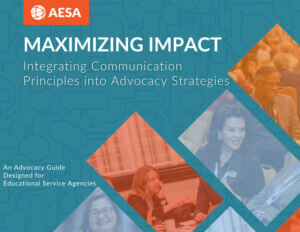 Educational Service Agencies play a critical role in supporting schools and districts, yet their unique needs and challenges often require tailored advocacy approaches. The recently released AESA Advocacy Guide recognizes the distinct position of ESAs and offers targeted strategies to help you navigate the complex landscape of education policy and funding.
Key Features of the toolkit include:
- Audience Analysis
- Message Development
- Channels & Content
- Advocacy Tactics
Advocacy is essential for ensuring that ESAs receive the support and recognition they deserve. With this specialized Advocacy Guide, you’re equipped to lead impactful advocacy efforts that can make a real difference. Download your copy today and take the first step towards stronger, more effective advocacy for your ESA.
SHARE YOUR ADVOCACY SUCCESS STORIES
AESA would like to highlight successful state-level advocacy campaigns. Share your triumphs in state advocacy with fellow members! Contribute to our newsletter by submitting your success stories – your experiences can enlighten and inspire others in navigating the often complex landscape of state advocacy. Together, we can amplify our collective knowledge for the benefit of the entire AESA membership. Send your stories to jwade@aesa.us.
STAY CONNECTED & INVOLVED
Have feedback for the AESA State Advocacy Team? Would you like to see a particular issue area addressed in future editions? Send feedback to jwade@aesa.us.