State Responses to Declining Enrollment. Student enrollment in K–12 public schools is dropping across the United States. National data shows enrollment fell by roughly 1.2 million students between 2019 and 2024, and many states project continued declines through 2030. At the same time, more families are choosing charter schools, private schools with state vouchers, homeschooling, and online learning options.
For educational service agencies (ESAs) and their client schools and districts, this is not just a local district problem. Declining enrollment affects state funding formulas, district budgets, and—directly—ESA revenue and sustainability. As states respond to these trends, ESA leaders need to understand what policy tools states are using, how those tools affect regional service agencies, and what ESAs can do to not just protect but amplify their role in a changing landscape.
Why enrollment matters for state funding. Most states fund K–12 schools using formulas tied to student counts—either enrollment (how many students are registered) or attendance (how many students show up each day). When student numbers drop, state aid to districts typically drops too. That creates budget stress for districts and, in many cases, for the ESAs that rely on state funding flows, service fees, or per-pupil allocations tied to district budgets – either through direct state funding or indirect fee-for-service models.
Three primary forces are driving enrollment declines:
- Demographic shifts – Fewer children are being born, and families are moving out of certain regions (especially older suburbs and rural areas) and into others (sunbelt states, growing metro areas).
- COVID-19 impacts – Pandemic-related enrollment drops have not fully reversed. Many students left public schools and have not returned, either because they aged out, moved to other options, or left the state.
- Growth of alternatives – Expanded voucher programs to nonpublic schools, charter school growth, and rising homeschool numbers mean public school enrollment is shrinking even in places where the total number of school-age children is stable or growing.
The result: fewer students in traditional public schools, which means less state aid—unless states change their funding rules.
Five state responses ESAs should know. States are trying different approaches to manage declining enrollment and its budget effects. Here are five recent examples that show the range of policy tools in play.
- Wisconsin: Consolidation incentives and supplemental aid
Wisconsin has responded to enrollment loss by encouraging school districts to consolidate or share services. In late 2025, the state passed AB 648 and AB 649, which provide supplemental state aid to districts that consolidate or implement whole-grade sharing arrangements.
Under current law, consolidated districts receive $150 per pupil for the first five years after consolidation, followed by reduced amounts in the sixth and seventh years. The new bills add funding for feasibility studies and provide grants to help districts explore regionalization and shared services before making final decisions.
What this means for ESAs: Wisconsin is creating financial incentives for districts to work together regionally. ESAs are well-positioned to coordinate feasibility studies, broker shared-service agreements, and serve as the administrative backbone for multi-district collaborations. If your state is considering similar consolidation policies, make sure ESAs are written into the enabling legislation as eligible grant recipients or required facilitators.
- Illinois: Targeted outreach for consolidation candidates
Illinois enacted HB 2966 in August 2025, which requires the State Board of Education to analyze consolidation grant requests and create a list of school districts that are strong candidates for consolidation based on overlapping boundaries, similar tax rates, and comparable funding adequacy levels. The law directs the State Board to communicate directly with superintendents and school boards on that list, informing them of available grant funds for consolidation feasibility studies and offering a list of neutral third-party organizations to conduct independent analyses.
What this means for ESAs: Illinois is moving from passive grant programs to active state outreach. ESAs should position themselves as the "neutral third parties" named in statute; entities that can conduct objective analyses, facilitate community conversations, and coordinate multi-district planning without the conflicts of interest that individual districts might face.
- California: Three-year enrollment averaging and the debate over attendance vs. enrollment
California funds schools using the Local Control Funding Formula (LCFF), which is tied to average daily attendance (ADA)—how many students actually show up, not just how many are enrolled. When the pandemic caused sharp attendance declines, the state added a three-year rolling average to the LCFF formula in 2022–23 for school districts and in 2023–24 for county offices of education. This averaging approach softens the impact of year-to-year attendance drops, giving districts more budget stability. However, chronic absenteeism remains high, and many California districts are pushing the state to shift from attendance-based funding to enrollment-based funding.
A January 2026 report by the Public Policy Institute of California (PPIC) examined this shift and found that moving to enrollment-based funding would cost the state about $3.8 billion but would benefit higher-need districts with lower attendance rates. The report also noted that statewide enrollment has fallen 7% since the mid-2010s and is projected to keep declining, which could create fiscal space for formula changes without cutting any district's budget.
What this means for ESAs: California's debate shows that states can use averaging mechanisms (like three-year rolling averages) and formula redesigns (like switching from attendance to enrollment) to stabilize budgets during enrollment declines. ESAs should understand which student-count method their state uses and whether averaging or hold-harmless policies protect ESA funding indirectly by stabilizing district budgets. This can be important in specific programs like child care and preschool where there is an increased push for attendance-based funding amid fraud claims in some states.
- New York: Foundation Aid formula updates and poverty data improvements
New York distributes most state school aid through its Foundation Aid formula, which calculates funding based on enrollment, student need (including students with disabilities and English learners), regional costs, and local property wealth. In early 2025, Governor Hochul proposed a 5.9% increase in Foundation Aid and two significant formula improvements:
- Updated poverty measures – Replace outdated 2000 census data with Small Area Income and Poverty Estimates (SAIPE) and count students in families participating in government assistance programs, not just those who qualify for free or reduced-price lunch.
-
- Increased state sharing ratio – Raise the maximum state share for high-need districts, so the state covers more of the cost for districts serving the most students in poverty.
These changes are designed to make the formula more responsive to current economic conditions and to direct more aid to districts with greater need, even as overall enrollment may decline.
What this means for ESAs: New York's approach shows that states can adjust funding formulas to better target resources without simply cutting budgets when enrollment drops. ESAs that serve high-need regions should advocate for similar formula improvements in their states—ensuring that declining enrollment does not automatically mean declining support for students and communities with the greatest challenges.
- Ohio: Voucher expansion and its impact on public school enrollment
Ohio has seen public school enrollment drop by nearly 27,000 students (1.8%) between 2020–21 and 2024–25, while private school enrollment increased by 18,327 students and charter school enrollment grew by 4,941 students.
In summer 2023, Ohio expanded its voucher system so that all families could qualify for state-funded scholarships to attend private schools, regardless of income or location. The number of students on paid vouchers increased from 69,675 in 2020–21 to 166,589 in 2024–25.
School funding experts note that Ohio's public school funding formula is still largely enrollment-based, so when students leave for private or charter schools, traditional public school districts lose state aid. ESAs that receive state funding tied to district enrollment or service counts are affected by the same dynamic. In Ohio, for example, state report card data has shown enrollment dropping by 30,000 students or 2% in the past two years. Over the past 5 years, enrollment has dropped by over 81,200 students, a 5.5% decline. As a result, Ohio ESCs have experienced $3,182,704.64 in unrealized revenue adjusted for inflation attributed to those lost students. In FY 2026, the current year, ESCs will receive $308,500 less than the amount appropriated less than one year ago due to a loss of 16,969 students this current year.
What this means for ESAs: States with expanding voucher or choice programs are likely to see continued enrollment shifts out of traditional public schools. ESAs need to understand how their state funding is linked to district enrollment and whether ESA revenue is protected by hold-harmless policies, multi-year averaging, or other stabilization mechanisms. In states without such protections, ESAs should advocate for statutory language that recognizes ESAs as regional infrastructure that serves students and districts regardless of where individual students enroll.
Hold-harmless policies: A short-term fix, not a long-term answer
Many states enacted "hold-harmless" policies during the pandemic to ensure that districts did not lose funding when enrollment or attendance dropped suddenly. These policies guarantee that a district receives at least as much state aid as it did in a prior year, even if student counts decline.
Hold-harmless provisions have helped districts (and indirectly, ESAs) avoid immediate budget crises. However, they also have significant drawbacks:
- They are temporary. Most hold-harmless policies are set to expire, and when they do, districts face delayed but often steep funding cuts.
- They can distort equity. By freezing funding at historical levels, hold-harmless policies often benefit districts with declining enrollment (and sometimes lower need) while limiting new funding for growing or higher-need districts.
- They don't solve the underlying issue. Hold-harmless buys time but does not address the structural challenge of serving fewer students with fixed or rising costs.
ESA leaders should ask: Does our state have a hold-harmless policy? When does it expire? And what happens to ESA funding when it ends?
What ESAs should ask during state funding debates
As states adjust funding formulas in response to declining enrollment, ESA leaders should be prepared to engage in those debates with clear questions and ideas. Here are key questions to ask:
- How is ESA funding tied to district enrollment or state aid?
Understand the legal and fiscal links between district budgets and ESA revenue. If ESA funding comes from:
- State appropriations tied to district enrollment counts
- Per-pupil service fees that decline when district enrollment falls
- Shared state aid distributed to districts and then to ESAs
Know the mechanism so you can advocate for protections.
- Does the state use enrollment averaging or hold-harmless policies?
If your state uses multi-year averaging (like California's three-year rolling average) or hold-harmless provisions, those tools may protect ESA funding indirectly by stabilizing district budgets. However, if those policies are temporary, plan for what happens when they expire.
- Are consolidation or regionalization policies creating new opportunities for ESAs?
States like Wisconsin and Illinois are actively promoting consolidation and shared services. If your state is considering similar policies, ESAs should be written into the legislation as:
- Eligible recipients of consolidation feasibility study grants
- Required facilitators or coordinators of regional service agreements
- Permanent infrastructure that receives supplemental funding when districts consolidate
- Is the state moving from attendance-based to enrollment-based funding, or vice versa?
The choice between enrollment and attendance can have major budget impacts. Enrollment-based funding is more stable and predictable; attendance-based funding can fluctuate with absenteeism and behavior trends. Know which method your state uses and how it affects both districts and ESAs.
- What is the state's long-term enrollment projection, and does the funding formula account for it?
Ask whether the state has published enrollment projections for the next 5–10 years. If enrollment is expected to continue declining, advocate for formula adjustments that recognize ESAs as long-term regional assets, not just pass-through entities whose funding rises and falls with yearly student counts.
The Bottom Line: ESAs must be proactive, not reactive
Declining enrollment is not a temporary blip. It is a structural shift driven by demographics, school choice policies, and changing family preferences. States are responding with a mix of tools—hold-harmless policies, enrollment averaging, consolidation incentives, and formula redesigns—and those tools will shape the fiscal landscape for districts and ESAs for years to come.
ESAs cannot afford to wait until funding cuts arrive. Instead, ESA leaders should:
- Understand their state's funding formula and how ESA revenue is tied to district enrollment or state aid.
- Track pending legislation on enrollment-linked funding, consolidation, and regionalization.
- Engage in state budget and policy debates with clear talking points, data, and proposed statutory language.
- Position ESAs as solutions to the challenges states face: regional efficiency, shared services, equity across districts, and stability during demographic change.
By moving proactively, ESAs can ensure that they are written into state policy as essential regional partners—not just service providers whose budgets rise and fall with student counts.
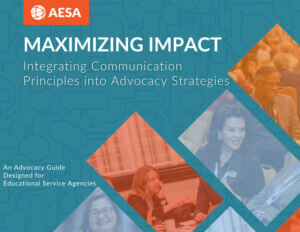 Educational Service Agencies play a critical role in supporting schools and districts, yet their unique needs and challenges often require tailored advocacy approaches. The recently released AESA Advocacy Guide recognizes the distinct position of ESAs and offers targeted strategies to help you navigate the complex landscape of education policy and funding.