What the Data Shows, What States Are Doing, and What it Could Mean for Educational Service Agencies
Overview
If you work for an educational service agency (ESA), you have likely heard the stories or witnessed the challenges firsthand. District superintendents and building principals describing classrooms where a single student in behavioral crisis disrupts learning for 25 others. Special education directors managing caseloads that no longer resemble what they were five years ago. Teachers leaving mid-year not because of pay, but because of what they encounter every day. What was once mostly anecdotal is showing up in the data. Federal civil rights data, national epidemiological surveys, and state-by-state legislative activity all point in the same direction: America's public schools are navigating significant behavioral and mental health challenges, and the systems designed to identify, support, and educate the most vulnerable students are under severe strain.
This month’s article seeks to summarize what is known to provide ESA leaders with a grounded, data-informed picture of the challenge and a clear view of the policy landscape taking shape around it. For ESAs uniquely positioned at the intersection of school support, specialized programming, and policy implementation, the moment is both urgent and full of opportunity to serve.
The Behavioral Health Surge
The numbers are striking. According to the CDC's Youth Risk Behavior Survey, 40% of high school students experienced persistent sadness or hopelessness in 2023 — up from roughly 26% a decade earlier. One in six youth ages 6–17 experiences a diagnosable mental health disorder each year, and the National Alliance on Mental Illness (NAMI) estimates that half of all lifetime mental health conditions begin by age 14. The American Academy of Pediatrics declared a national emergency in child and adolescent mental health in 2021. Three years later, the emergency has not abated.
From 2016 to 2021, the CDC documented statistically significant increases in the lifetime prevalence of anxiety disorders, depression, learning disabilities, and developmental delays among children ages 3–17. As of April 2022, 69% of public schools reported an increase in mental health concerns among students compared to pre-pandemic baselines. In the most recent national data available, nearly 1 in 5 public school students — 18% — utilized school-based mental health services in 2024–25.
How This Surge Shows Up in School Records
For those tracking school data systems, the behavioral health surge shows up most visibly in Section 504 plan growth. Section 504 of the Rehabilitation Act — a civil rights statute that entitles students with disabilities to accommodations in general education — has seen explosive enrollment growth, measured through the federal Civil Rights Data Collection (CRDC). Nationally, the share of students on 504-only plans grew from approximately 1.0–1.2% of public school enrollment in 2005–06 to approximately 4% by 2021–22 — a near-quadrupling in roughly 15 years.
The single greatest accelerant may be the ADA Amendments Act of 2008 (ADAAA), which broadly expanded the definition of disability to include conditions that substantially limit major life activities — including anxiety, depression, ADHD, and PTSD. Overnight, conditions that had been difficult to qualify under Section 504 became clearly eligible. Schools that had been cautious about 504 identification began writing plans with greater frequency, and the pipeline from mental health diagnosis to school accommodation grew substantially.
What the data does not show is a corresponding rise in the IEP disability category most directly associated with behavioral and emotional needs. The Emotional Disturbance (ED) category under IDEA — which covers students whose emotional or behavioral conditions adversely affect educational performance and require specially designed instruction — has actually declined as a share of students with disabilities, dropping from 7.1% in 2008–09 to just 4.35% in 2023–24. In absolute numbers, ED identification fell from approximately 365,000 students in 2014–15 to about 327,000 in 2022–23, even as behavioral health needs were escalating nationally.
This paradox has a structural explanation. Students with anxiety, depression, and even moderate ADHD are increasingly being routed to Section 504 rather than IDEA — receiving accommodations (extended time, reduced workload, quiet testing) without the specially designed instruction that an IEP would require. This is less costly for schools, quicker to implement, and carries less procedural burden. Whether it is always the appropriate level of support is a question the data cannot answer — but it is a question ESA leaders and advocates are uniquely positioned to ask.
What the Discipline Data Shows: A Complicated National Picture
The formal discipline data presents what may seem like a reassuring picture at first glance: national rates of school-related violence, weapons possession, and student arrests have generally declined since peaks in the early 2010s. A detailed 2024 analysis of federal data described the 2021–22 school year as among the safest in a decade by most crime-related metrics.
And yet, 72% of educators surveyed by EdWeek Research Center in December 2024 said students misbehave more than before the pandemic. Nearly half said behavior had gotten "a lot worse." The disconnect is real: formal criminal or safety metrics are stable or declining, but lower-level behavioral disruption (emotional dysregulation, defiance, outbursts, chronic non-compliance) is substantially higher by virtually every educator account. These are not incidents that rise to the level of a law enforcement report. They are the day-to-day fabric of what is making teaching unsustainable for many professionals, and what is making learning nearly impossible for many students.
Where the formal data does tell a clear and consistent story is in the disproportionate disciplinary treatment of students with disabilities. According to the most recent CRDC data (2021–22):
- Students with disabilities represent approximately 17% of public school enrollment but account for 27–29% of all in-school suspensions, out-of-school suspensions, and school-related arrests.
- Students with disabilities are twice as likely to be suspended as their non-disabled peers.
- 77% of students subjected to seclusion are students with disabilities with autism spectrum disorder heavily overrepresented.
By disability category, Emotional Disturbance (ED) carries by far the highest discipline rate of any IDEA category — suspended and expelled at rates 3–4 times the overall student average. Other Health Impairment (OHI), which includes ADHD, is the second most frequently disciplined category. Students with Specific Learning Disabilities (SLD) follow.
State Policy Responses: What Legislatures Are Doing
The 2025 legislative sessions were among the most active in recent memory on these three interconnected issues. The political landscape is not simple: states are simultaneously investing in behavioral health infrastructure and expanding punitive discipline authority, often within the same statehouse, sometimes in the same bill.
Mental Health Investments
More than 30 governors referenced student mental health in their 2025 State of the State addresses, and a Pew Charitable Trusts analysis found it among the top 5 cross-partisan education themes. Legislative highlights include:
- Nevada (SB 314): Required all teacher licensure programs to include mental health coursework and mandated ongoing professional development in social-emotional learning for existing teachers and administrators.
- Arkansas: Passed a $7 million initiative combining student device/phone restrictions with telehealth connections for mental health services.
- California: Enacted multiple bills (SB 14, SB 224, AB 309) requiring mental health absences to be treated as excused, mandating mental health literacy in secondary health curricula, and directing the state's Department of Education to create model referral protocols for all school systems.
- New York: Governor Hochul proposed expanded mental health investments in FY26, including school counselor pipeline funding, in parallel with cellphone restriction legislation.
Special Education Funding Reform
This was arguably the highest-stakes arena in 2025. Two states led the way:
- Texas enacted the most significant state-level special education structural reform in the country in 2025. Senate Bill 568 shifted Texas from a placement-based funding model (where reimbursement is tied to where a student is educated) to a service-intensity model (where funding reflects the complexity and level of services required). This change, long advocated by disability rights organizations and equity researchers, removes the perverse incentive to place students in more restrictive settings to maximize reimbursement. Texas also created a parent-directed supplemental services grant of $1,500 per eligible student.
- Connecticut passed HB 5001, a bill that invested $30 million in a new Special Education Expansion and Development (SEED) grant to help districts build in-house capacity for students currently placed in costly out-of-district settings, regulated third-party private provider billing rates, raised developmental delay eligibility age to 8, and required behavioral assessments and intervention plans before any out-of-district placement. That last provision signals a meaningful shift toward early, in-district behavioral intervention as a policy priority.
Discipline Legislation: A Divided Response
State discipline legislation in 2025 reflected genuine ideological tension. The authoritarian and the preventive impulse were both well-represented:
- On the side of expanded removal authority: West Virginia enacted a law allowing teachers to remove students who make threatening or intimidating statements. Arkansas' Teacher and Student Protection Act prevented a removed student from returning to the same teacher and/or class environment. Texas advanced legislation extending the permissible length of in-school suspension beyond previous limits and codifying teacher-initiated removal authority.
- On the side of limiting punitive discipline: Colorado clarified and restricted the permissible use of physical restraint. Illinois moved to limit preschool suspension authorization and duration. Multiple states including Maryland, Washington, and Michigan advanced or enacted bills restricting the use of suspensions for students in early grades.
Implications for Educational Service Agencies
The convergence of rising mental health need, structural identification gaps, and contested discipline policy creates a set of compounding risks for schools and students that educational leaders must understand clearly. For ESAs, this landscape is at once daunting and defining. ESAs exist precisely to do what individual districts, particularly smaller and rural ones, cannot do alone: provide specialized capacity, shared expertise, and cost-effective services at scale. The behavioral health and special education crises are generating demand across every one of those dimensions.
- The national policy environment is naming ESAs as part of the solution. The Education Commission of the States' September 2025 special education funding report explicitly identified regional education service agencies as one of four primary state policy levers for serving students with complex needs — specifically as a mechanism for building high-cost service capacity outside individual district budgets.
- Programmatic opportunities are growing. The single most underserved gap in the system right now is early behavioral identification and Tier 2/Tier 3 behavioral intervention. PBIS (Positive Behavioral Interventions and Supports) coaching, functional behavioral assessments, behavior intervention plan development, trauma-informed practice training, and school-based mental health consultation are all services that ESAs can and, in many cases, already do provide, but demand is accelerating well beyond current capacity. ESAs that can document outcomes, build referral pipelines with districts, and demonstrate cost-effectiveness relative to out-of-district placements are in an exceptionally strong position.
- The advocacy framing is bipartisan. The data on behavioral health, discipline disproportionality, and identification gaps is simultaneously a fiscal argument (early intervention costs far less than out-of-district placement, incarceration, or adult mental health treatment) and a moral one (every student deserves appropriate identification and support). Investments in ESA behavioral health capacity serve conservative fiscal priorities and progressive equity priorities at the same time. That is a rare and valuable position in today's legislative environment.
Five Takeaways for ESA Leaders
The evidence is no longer anecdotal. The behavioral health and special education challenge facing schools across the country is documented, persistent, and accelerating. ESA leaders who understand the data and the policy landscape are positioned to lead with both urgency and credibility.
- The 504 surge is behavioral health in disguise. Fourfold growth in 504 plans over 15 years reflects a generation of students with anxiety, depression, ADHD, and trauma-related needs that the special education system is only partially capturing. ESAs should be assessing whether districts they serve have appropriate identification, evaluation, and support processes at the 504 and early IEP levels.
- The ED category undercount could be a structural problem, not a data quirk. Declining ED identification in the face of rising behavioral health need may suggest some students are not receiving the level of support they need. ESAs can play a critical role in supporting districts in defensible, appropriate identification and in building the behavioral intervention programming that makes IEP services viable.
- Discipline disproportionality is both a legal exposure and a human cost. Students with disabilities are suspended at twice the rate of their non-disabled peers nationally. ESAs offering PBIS, restorative practice, and behavior support frameworks are directly addressing a documented legal risk and educational harm.
- The state and national policy environment is moving, and ESAs need to be in that conversation. Texas and Connecticut enacted landmark special education reforms in 2025. The Education Commission of the States named regional ESAs as a policy solution. States’ next budget cycles and legislative sessions are an opportunity to make the case for ESC investment using the same data and framing driving legislative action in peer states.
- Document, measure, and communicate outcomes. The single most powerful thing ESAs can do in this environment is demonstrate that their behavioral health and special education programming works — in student outcomes, in cost-per-pupil comparisons, and in reduced restrictive placements.
ESA leaders cannot afford to sit on the sidelines of this crisis; the same data that documents rising behavioral health needs and special education strain also makes a compelling, bipartisan case for investing in regional capacity, early intervention, and evidence-based behavioral supports. By leaning into their role as conveners, innovators, and policy partners, ESAs can help shift the trajectory from reactive discipline and costly placements to proactive identification, robust in-district services, and measurable gains for students and the educators who serve them.
Sources for this article include the U.S. Department of Education Civil Rights Data Collection (CRDC); the National Center for Education Statistics; the CDC Youth Risk Behavior Survey; the Education Commission of the States; the National Conference of State Legislatures; the Pew Charitable Trusts; Children's Defense Fund; the Ohio Department of Education and Workforce; the Center for Learner Equity; and the Learning Policy Institute.

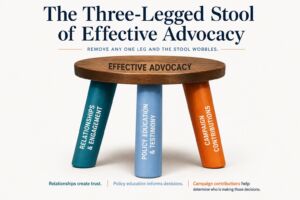 The First Leg: Relationships and Engagement. This is the day-to-day work of advocacy — meeting with legislators and their staff, attending community events, building personal credibility as a trusted source of information on education policy.
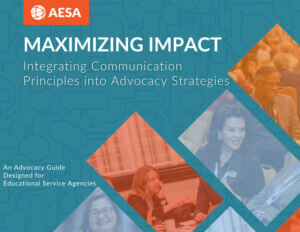 Educational Service Agencies play a critical role in supporting schools and districts, yet their unique needs and challenges often require tailored advocacy approaches. The recently released AESA Advocacy Guide recognizes the distinct position of ESAs and offers targeted strategies to help you navigate the complex landscape of education policy and funding.